
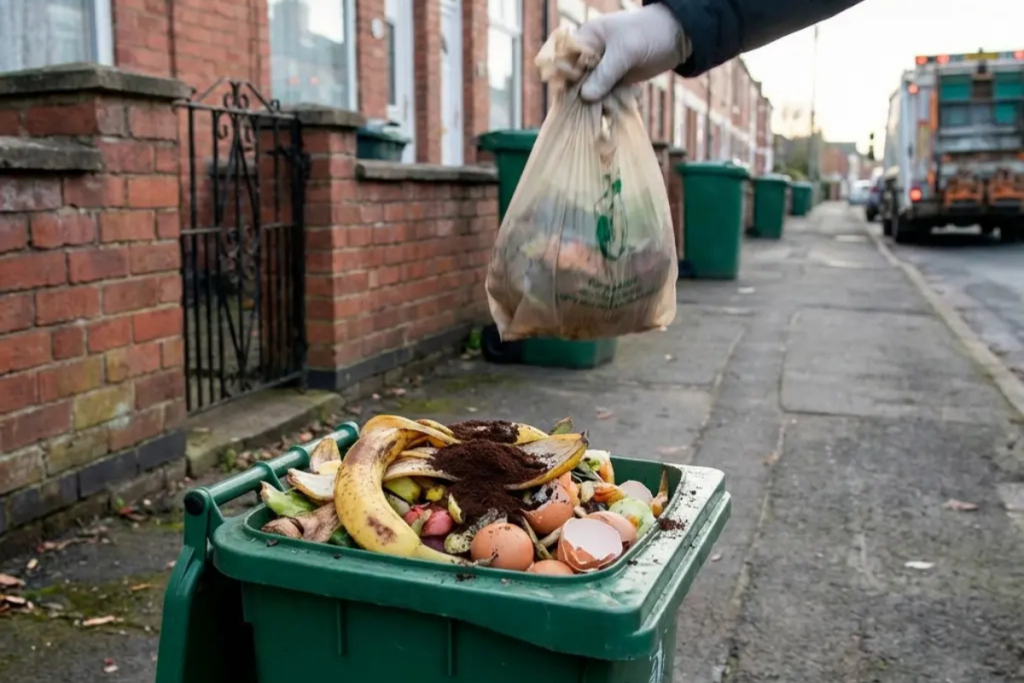
People are posting glamour shots of their kitchen bins on social media.
Derby residents became “binfluencers” after the city started handing out green food waste containers to every household. They’re sharing caddy placement tips, comparing container setups, and competing to show off their waste sorting skills. The problem? Collection services don’t start until March 31, 2026.
The city had to beg people to stop filling their bins.
This is happening in every local authority in England right now. It’s the largest infrastructure shift in waste management since recycling bins showed up in the 1990s. And what’s unfolding in Derby shows exactly how complicated it gets when national environmental policy lands on your doorstep.
The Three-Month Gap Nobody Talks About
Derby is distributing containers across the city starting in January 2026. Residents get their bins. They get their kitchen caddies. They get instruction sheets.
Then they wait. Nearly three months.
You see a green bin on your doorstep and assume the system is ready. It’s not. Behind that bin: collection routes that need mapping, processing facilities that need capacity testing, workers who need training, trucks that need routing algorithms.
Delivering the bin is the easy part.
Derby’s phased rollout moved from Mickleover through Mackworth to Allestree because you can’t flip a switch on 100,000 households at once. The infrastructure builds slowly while the bins sit empty on doorsteps.
A national mandate from Westminster becomes a logistical puzzle in Derby, and every city is running the same operation with different timing.
The Technology That Changed the Rules
Derby’s system accepts any bag.
Plastic bags. Compostable liners. Old bread bags. Newspaper wrapping. The processing facility strips everything out before the organic material hits the anaerobic digestion chambers.
This is huge. Traditional composting operations demanded specific materials because contamination ruined entire batches. You needed the right liner or your participation didn’t count. One wrong bag and your food waste goes to the landfill anyway.
Derby ditched the purity test.
Getting food waste out of black bins matters more than what bag it arrives in. Volume beats perfection.
Every requirement you add to a public program creates a failure point. People forget the right bags. They run out. They get confused about what qualifies.
UK households waste £470 worth of food annually, with 6.4 million tons being edible at disposal. Getting that volume diverted from landfills matters more than the type of container it arrives in.
When Enthusiasm Breaks Your System
Councillor Ndukwe Onuoha had to issue a public plea: Stop filling your bins.
Too late. People already turned food waste sorting into a competitive sport. Instagram and neighborhood Facebook groups are filled with setup photos. Kitchen caddy placement debates. Container configuration tips.
Hand someone a bin, and they’re going to fill it.
This is what happens when environmental action becomes a status symbol. Participation isn’t just compliance anymore—it’s identity. People want to prove they’re the most committed, the most organized, the best at sorting.
Derby created the enthusiasm. Then had to contain it until the trucks showed up.
The Housing Infrastructure Problem
Derby’s standard model works great if you live in a detached or semi-detached home. The container shows up. Sits outside. Gets collected weekly.
Then you hit flats.
Multi-dwelling units need custom solutions. Where do containers go? Who manages communal bins? How do you stop contamination when 20 households share one collection point? What about buildings with no outdoor storage?
These properties require direct officer consultation because the standard system doesn’t work. Waste collection was designed for suburban houses with driveways and garden space. Urban density breaks that model.
Housing type determines service quality.
Residents in houses get automatic enrollment. Residents in flats get consultation requirements and longer waits. The system creates inequality based on where you live, and housing type tracks closely with income.
Derby isn’t ignoring this—they’re accommodating it. But accommodation doesn’t fix the underlying problem: infrastructure built for one kind of living struggles with another.
The Circular Economy in Action
Here’s where it gets interesting: your food waste becomes valuable.
Derby’s contract diverts 4,845 tons of food waste annually to anaerobic digestion facilities. Bacteria break down your banana peels and chicken bones in oxygen-free tanks. What comes out the other side? Renewable energy and fertilizer.
Processing 100 tons of food waste daily generates enough energy to power 800 to 1,400 homes annually. Food waste produces three times more methane than biosolids, making it an exceptional fuel for energy generation.
Your garbage powers someone’s house.
This flips the entire economic model. You’re not paying the city to haul away a problem. You’re feeding raw material into a production system that generates electricity and sells fertilizer.
The environmental math works too. Food waste in UK landfills generates 25 million tons of CO₂-equivalent emissions annually. Methane traps 86 times more heat than carbon dioxide over 20 years.
When you divert organic waste from landfills, you stop that methane from hitting the atmosphere. And instead of just preventing harm, you’re creating energy.
Derby also saves £240,000 annually by sending garden waste to outdoor composting instead of more expensive In-Vessel Composting. Match the waste type to the right processing technology, and costs drop while outputs increase.
The Nationwide Cascade
Derby isn’t unique. They’re just early.
The March 31, 2026, deadline applies to every local authority in England. Right now, only 41% of UK citizens have access to food waste recycling. That needs to hit 100% within a year.
Westminster passes legislation. That legislation cascades down through governance layers until it becomes a green bin on your doorstep and a shift in your daily routine.
The UK must increase recycling rates from 44.6% to 65% by 2035. England’s household recycling rates have flatlined since 2015. Food waste collection is how they plan to hit those targets under the Environment Act 2021.
Your participation isn’t optional. It’s the law.
But legislation doesn’t guarantee compliance. Derby’s rollout proves you need more than mandates. You need trucks, routes, facilities, communication plans, and the ability to adapt when reality doesn’t match the policy document.
Right now, every city in England is running this same implementation. Each one is hitting the multi-month preparation gaps, the enthusiastic residents, the flat-dwelling complications, and the infrastructure mismatches. They’re all discovering that turning policy into practice requires coordination that nobody fully anticipated.
What This Means for You
So what happens next?
If Derby’s experience is a preview, expect delays. Expect communication gaps. Expect your neighbors to start competing over who’s better at sorting vegetable peelings.
But also expect this to work. UK households waste £470 worth of food annually—6.4 million tons, that’s still edible when it hits the bin. Getting even half that volume into energy production instead of landfills shifts the environmental equation.
Your city is about to change how it handles organic waste. Municipal governments are becoming resource recovery operations, not just garbage collectors. Your waste stream is now an input to production systems that generate electricity and fertilizer.
This isan infrastructure change that depends on your daily habits.
The interesting part isn’t the bins or the trucks or the processing plants. It’s watching how cities coordinate massive logistical operations with individual household behavior. National environmental targets only work if you actually scrape your dinner plate into the right container.
Derby shows what that coordination looks like in practice: messy, slower than expected, inequitable in places, but ultimately functional. The preparation gaps exist because systems take time to build. The flat-dwelling complications exist because infrastructure wasn’t designed for how people actually live. The binfluencer phenomenon exists because people want environmental action to mean something visible.
Your banana peel just became part of a production system. Whether that system works at scale depends on hundreds of simultaneous implementations across England, each one adapting the policy to local reality.
Watch your local authority’s rollout. The way they handle the complexity tells you more about how environmental policy actually functions than any government announcement ever will.
