
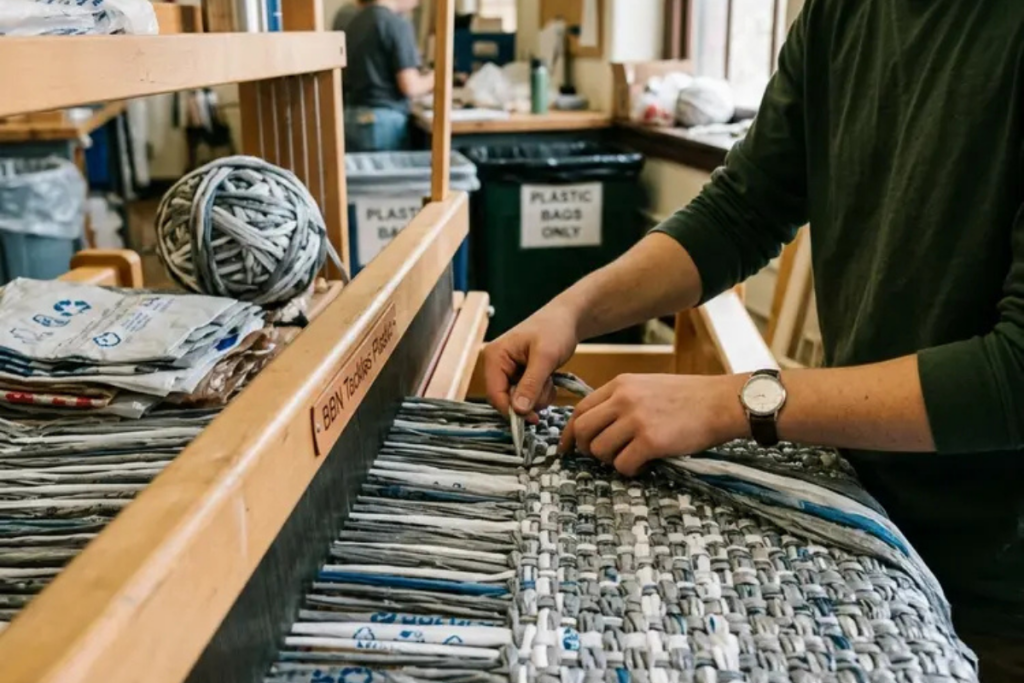
I never expected to care about plastic bags. When Shayna Bassi, a University of Kentucky senior, showed me how she turned campus waste into sleeping mats for people experiencing homelessness, I saw a simple system solving multiple problems at once.
The Problem Nobody Wants to Talk About
You probably think tossing a plastic bag in your recycling bin helps. It doesn’t. Those bags tangle in sorting equipment, shut down entire facilities, and contaminate batches of otherwise recyclable materials. One recycler spends $9,500 extra per month just untangling bags from machinery.
In 2018 alone, 3.04 million tons of plastic bags went to landfills. The recycling rate? A pathetic 10 percent.
Each bag takes 1,000 years to break down. So what do we do with them?
Bassi asked a better question: What if we gave these bags a second life before they hit the landfill?
How BBN Tackles Plastic Actually Works
Bassi placed collection bins in residence hall lobbies. Students drop plastic bags in the bins instead of tossing them in trash or contaminating recycling. The Sustainability Future Leaders student organization collects the bags, cleans them, and weaves them into sleeping mats.
Each mat requires 700 to 900 bags and takes 15 to 20 hours to make.
The mats go to The Hope Center, which distributes them to Lexington residents without housing. The mats are waterproof, provide insulation from cold ground, and can be hosed clean. For people living outdoors, they’re not symbolic. They’re functional.
The program started with three residence halls in spring 2026, expanded to seven by fall, and Bassi plans full campus coverage soon.
The first 1.5 months brought 850 bags: roughly one complete mat per month.
Why Residence Halls Matter More Than You Think
On-campus students generate significantly more waste than commuters. They eat more meals on campus, order more deliveries, and accumulate more packaging. Residence halls are concentrated waste production zones.
Ryan Lark, UK’s zero-waste specialist, confirmed this. Targeting high-impact areas creates measurable results faster than campus-wide campaigns that dilute effort.
Residence halls work for another reason: convenience drives behavior change.
When you put a collection bin in a lobby where students already walk, participation requires zero extra effort. No special trips. No complicated sorting. Just drop the bag and go.
It’s basic human psychology applied to waste systems.
The Dual-Purpose Model That Changes Everything
Most sustainability programs solve one problem. BBN Tackles Plastic solves two: environmental waste and community welfare.
Dual-purpose initiatives create exponential value. Every bag collected prevents landfill contamination and contributes to homeless support. Every student who participates learns about waste systems and community responsibility.
Universities wield massive economic power. With more than 4,300 higher education institutions across the United States, their collective purchasing decisions and waste generation create ripple effects far beyond campus boundaries.
The University of Melbourne’s material flow analysis found that procurement-related purchases alone represented enough embodied energy to build 8 new average houses and enough water to fill 12 Olympic swimming pools every single year. That’s one campus.
BBN demonstrates this at micro-scale. Bags that would cost the university money to process through waste systems now become community resources at near-zero cost.
What Actually Drove Institutional Buy-In
Bassi built strategic partnerships with UK Recycling, Residence Life, and The Hope Center. Each partner brought infrastructure, expertise, or distribution channels that a student organization couldn’t access independently.
Student-led initiatives need institutional support to scale.
Campus sustainability competitions show that just 200 participating colleges and universities diverted over 29 million pounds of waste from landfills. With more than 4,300 higher education institutions across the United States, student-led programs have massive potential impact.
Potential only converts to results when institutions provide resources, space, and legitimacy.
UK gave Bassi all three. The recycling department provided collection infrastructure. Residence Life approved bin placement. The Hope Center offered distribution networks.
The program aligned with UK’s five guiding sustainability principles, which gave administrators a framework to say yes.
The Hidden Challenges Nobody Mentions
Making sleeping mats sounds simple until you actually do it.
Each mat takes 15-20 hours of labor. Volunteers need training. Bags need cleaning before weaving. The process is slow, repetitive, and physically demanding.
Over two years, the program produced 20 mats. This year, they’ve completed eight more.
Not fast. But steady. And steady matters more than speed when you’re building sustainable systems.
Collection consistency poses another challenge.
Students forget to bring bags. Bins overflow during busy periods. Contamination happens when people toss non-plastic items in collection points.
Bassi addressed this through education and bin monitoring, but it requires ongoing attention. Systems don’t run themselves.
What This Means for Your Community
You don’t need a university to replicate this. You need three things:
1. A collection point where people already gather
Apartment lobbies, community centers, churches, grocery stores. Put bins where foot traffic already exists.
2. A partner organization that serves your target community
Homeless shelters, community outreach programs, social service agencies. They handle distribution so you focus on collection.
3. Volunteers willing to commit 15-20 hours per mat
This isn’t passive recycling. It requires active labor. Be honest about time requirements upfront.
No special equipment. No expensive infrastructure. No complex logistics.
Just bags, time, and commitment.
The Broader Shift Happening on Campuses
BBN Tackles Plastic is bigger than one program at one university.
Universities are recognizing responsibility to surrounding communities beyond academic contributions. The partnership with The Hope Center demonstrates evolving understanding of institutional citizenship.
This town-gown collaboration model is spreading. Universities increasingly view themselves as community anchors, not isolated academic islands.
The timing matters too. Bassi distributes mats at the end of each school year, when production accumulates and weather makes outdoor living more viable. This seasonal approach shows sophisticated operational planning that aligns production with community demand.
Students engaged in programs like this develop stronger environmental responsibility that lasts beyond graduation, adopting sustainable practices throughout their careers and communities.
Not just 850 bags diverted. Hundreds of students learning that waste systems can serve dual purposes.
What I’d Do Differently
If I were launching this program from scratch, I’d focus on three improvements:
Track detailed metrics from day one. Bags collected per location, participation rates by building, seasonal variations. Data drives expansion decisions and funding requests.
Build volunteer recruitment into the system. Mat-making requires sustained labor. Create a pipeline that recruits new volunteers as others graduate or move on.
Document the process visually. Photos, videos, time-lapses of mat creation. Visual content drives awareness and recruitment better than any written explanation.
These are lessons I learned from watching similar programs scale and struggle.
Can This Actually Make a Difference?
Yes, but not in the way most people think.
Look, 850 bags per month won’t solve the plastic crisis. Eight mats per year won’t end homelessness. I get that.
But here’s what it does do: it proves waste doesn’t have to be waste. Environmental programs can serve social needs. Students can drive institutional change when they build the right partnerships.
BBN Tackles Plastic proves that simple systems, consistently executed, create measurable impact on multiple fronts.
You don’t need a massive budget or complex infrastructure. You need a clear problem, a functional solution, and the discipline to keep showing up.
What I learned from watching 850 plastic bags become a sleeping mat: the bags were never the point. The system was.
