
We throw away 92 million tons of textiles every year.
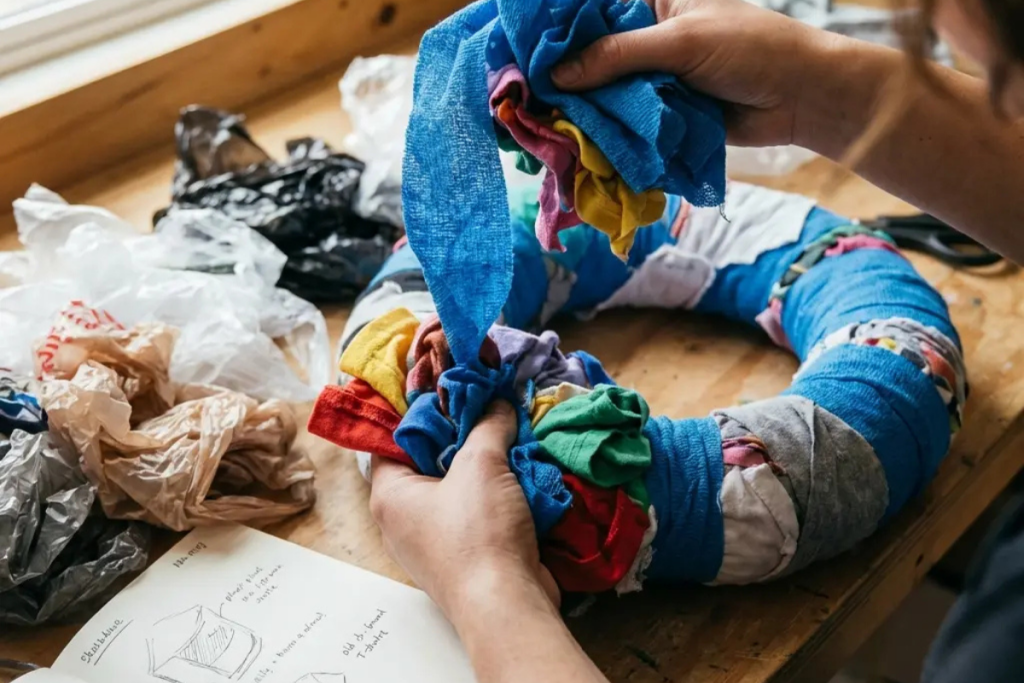
Anna Quarles spent five hours stuffing donated T-shirts, medical blue wrap, and plastic grocery bags into four circular cushions. The University of Kentucky design student threaded them together into a modular children’s chair—bright blue and white, soft to the touch, reconfigurable into different shapes.
Total material cost: zero dollars. Total waste diverted: enough to fill a small closet.
The assignment for her Soft Spaces class was simple: create soft furniture. What Quarles discovered reveals how universities waste thousands of pounds of usable materials—and how design students could stop it.
The Material Came First
Traditional furniture design starts with sketches and mood boards. Designers imagine what they want to build, then source materials to match that vision. They control the color palette, the texture, and the exact specifications.
Quarles worked backward.
She contacted Erin Geibel, the coordinator at UK Recycling, after her professor, Jennifer Meakins, suggested it. The recycling center had been collecting medical blue wrap since 2015. They had bags full of donated T-shirts from campus events. They had plastic grocery bags that people dropped off.
The design emerged from what was available, which changed everything—form, function, and possibility all shifted. Constraints became the creative engine.
The chair took shape as four circular structures that thread together. The empty center space lets the pieces connect and reconfigure based on different needs. A kid can use it as a chair today, rearrange it as a cushion fort tomorrow, and adapt it as they grow.
That adaptability—rearrangeable, reconfigurable, growing with the child—came directly from working with what was there, not from unlimited options.
Universities Generate More Waste Than You Think
Higher education institutions intercept 30 to 40 tonnes of unwanted items annually through reuse schemes.
Universities collect enough discarded items annually to fill multiple garbage trucks. Event T-shirts were printed in bulk but never distributed. Furniture from dorm rooms abandoned at semester’s end. Medical supplies from health centers that meet regulatory standards but can’t be reused clinically.
UK’s blue wrap program is a perfect example. Hospitals use this polypropylene plastic to wrap surgical instruments. It’s clean, consistent, and made from 99% plastic #5, which is highly recyclable.
But less than 1% actually gets recycled.
The material ends up in landfills not because it’s contaminated or unusable, but because the infrastructure to process it doesn’t exist at scale. One Wisconsin hospital recycled nearly 25,000 pounds of blue wrap in 2021, representing 13% of its total biohazard waste.
Multiply that across thousands of healthcare facilities, and the scope of clean, usable material thrown away becomes clear—simply because we haven’t built systems to capture it.
The Five-Hour Stuffing Process
Quarles spent five hours stuffing the chair components.
This exposes the reality of sustainable design work: labor-intensive, time-consuming, requiring patience that most commercial production timelines don’t allow.
That time investment created a prototype that now sits in the Gray Design Building, where other students can see it, touch it, and understand that furniture made from campus waste is possible.
The chair serves two functions.
First, it’s functional children’s furniture demonstrating modular design principles. Second, it’s a teaching tool showing incoming design students what material-first thinking looks like in practice.
A physical object made from T-shirts and medical wrap makes the abstract concept of the circular economy concrete. Sustainability stops being something that happens in specialized facilities with expensive equipment.
It becomes something students could do next semester.
Constraints Drive Market-Ready Solutions
Limited materials force innovation. Modular design approaches shorten product design cycles and extend product lifecycles by building adaptability into the original structure.
The children’s furniture market is experiencing 18% growth in modular systems that adjust as children grow. More than 28% of parents now prioritize environmentally friendly materials, with 32% seeking recyclable components.
Parents want furniture that doesn’t end up in landfills two years later when their kid outgrows it. They want materials that won’t poison their children or the planet. They want designs that adapt instead of becoming obsolete.
Quarles’s project addresses all three concerns, not through sophisticated engineering, but by designing within the constraints of available recycled materials.
The modularity wasn’t a feature she added for market appeal. It emerged from figuring out how to work with irregular fabric pieces and create something that could be reconfigured.
Collaboration Unlocks Material Sources
Quarles couldn’t have completed this project without Erin Geibel at UK Recycling.
That connection happened because her professor knew who to call. It happened because UK Recycling had already established collection programs for materials like blue wrap. It happened because someone had built the infrastructure to capture and store these materials instead of sending them straight to landfills.
Individual sustainability efforts gain exponential impact when embedded in supportive systems.
Without institutional programs to collect and redistribute waste materials, designers start from scratch every time—calling random facilities, spending weeks sourcing materials instead of days.
UK Recycling’s blue wrap program has been running since 2015. That’s nearly a decade of consistent material collection that students can now tap into for projects.
This is what infrastructure looks like.
That boring, administrative work makes projects like Quarles’s possible.
What This Means for Design Education
Design schools traditionally teach students to imagine freely, then figure out how to execute their vision.
This approach works for learning fundamentals. Students need to understand what’s possible before limiting themselves.
But real-world projects don’t come with unlimited budgets or perfect material access. Designers need the skill of creating compelling work with what’s available.
Material-first methodology teaches that skill.
The Soft Spaces class at UK focused on soft furniture construction through knitting, weaving, and hand stitching. These techniques require understanding your materials intimately because you’re manipulating them directly with your hands.
When you spend five hours stuffing a chair with donated T-shirts, you’re not thinking abstractly about “textile waste streams.” You’re thinking about the specific texture of that fabric, how it compresses, how it holds shape.
Five hours of stuffing T-shirts forces a mindset shift: materials become resources, not trash.
The Bigger Picture on Campus
Universities would rank as the 21st largest economy globally based on their spending power.
That purchasing power gives institutions immense leverage to drive circular economy transitions. When a university commits to sustainable procurement, it sends market signals that influence how products get designed and manufactured.
What happens to materials after they’ve served their initial purpose matters equally. Campus reuse schemes achieve a 27% reduction in delivery costs while maintaining environmental benefits, proving that circular approaches can be economically viable.
Quarles’s project demonstrates what happens when students can access these material streams for creative work. The chair cost nothing in materials. It diverted waste from landfills. It created something functional and educational.
Every design student could have similar access to institutional waste streams.
Architecture students could source reclaimed building materials from campus renovation projects. Engineering students could access broken electronics for reverse engineering practice. Art students could use surplus office supplies for installations.
The infrastructure already exists to collect many of these materials. What’s missing is the connection between waste management systems and creative programs.
What You Can Actually Do
If you’re a student: Find out who coordinates recycling or surplus property at your institution.
Ask what materials they collect. Ask if students can access those materials for projects. Ask if there are liability concerns and how those might be addressed.
Most coordinators want to see materials reused instead of thrown away. They’re often happy to help if someone asks.
If you’re faculty: Build material sourcing into project requirements.
Instead of telling students to buy supplies, require them to source at least 50% of materials from waste streams. Introduce them to the facilities management staff who can help. Make constraint-based design a core skill, not an optional challenge.
If you’re in facilities management, document what materials you collect and make that information accessible.
A simple system works: a shared spreadsheet updated monthly showing what’s available. No sophisticated database needed.
The barrier isn’t usually the materials themselves.
The barrier is knowing materials exist and having permission to use them.
What Happens Next
Switching to renewable energy and improving energy efficiency can address about 55% of global emissions.
The remaining 45% comes from how we make, use, and dispose of products and food.
Solar panels can’t solve material waste. Changing how things get designed, used, and recirculated can.
Universities function as testing grounds for circular approaches. They have diverse waste streams, fabrication facilities, and populations willing to experiment. When a student proves that campus waste can become functional furniture, that proof-of-concept scales to commercial applications.
The children’s furniture market is already moving toward modular, recyclable designs. Medical facilities are exploring blue wrap recycling programs. These shifts are happening because someone demonstrated they were possible.
The chair is evidence that material-first design works. Those constraints drive innovation. Institutional waste streams contain valuable resources.
The finished chair sits in the Gray Design Building now—bright blue cushions with white accents, arranged in a low seat configuration. Students walk past it between classes. They stop, touch the fabric, and read the placard explaining the recycled materials. Some photograph it. Some sit in it. Some stand there thinking about their own projects, wondering what they could create from materials that would otherwise get thrown away.
Sustainability isn’t an individual virtue. It’s building systems that make sustainable choices easier than wasteful ones. Connecting people who generate waste with people who can transform it. Teaching the next generation of designers to see constraints as creative fuel.
Anna Quarles needed fabric. She found it in campus waste streams. She spent five hours stuffing recycled materials into a modular design.
The chair now teaches other students that this approach is possible. Not through proclamations about saving the planet, but through practical demonstration.
That’s how change happens. One project at a time. One collaboration at a time. One chair in one building, showing students what they could do next semester.
