
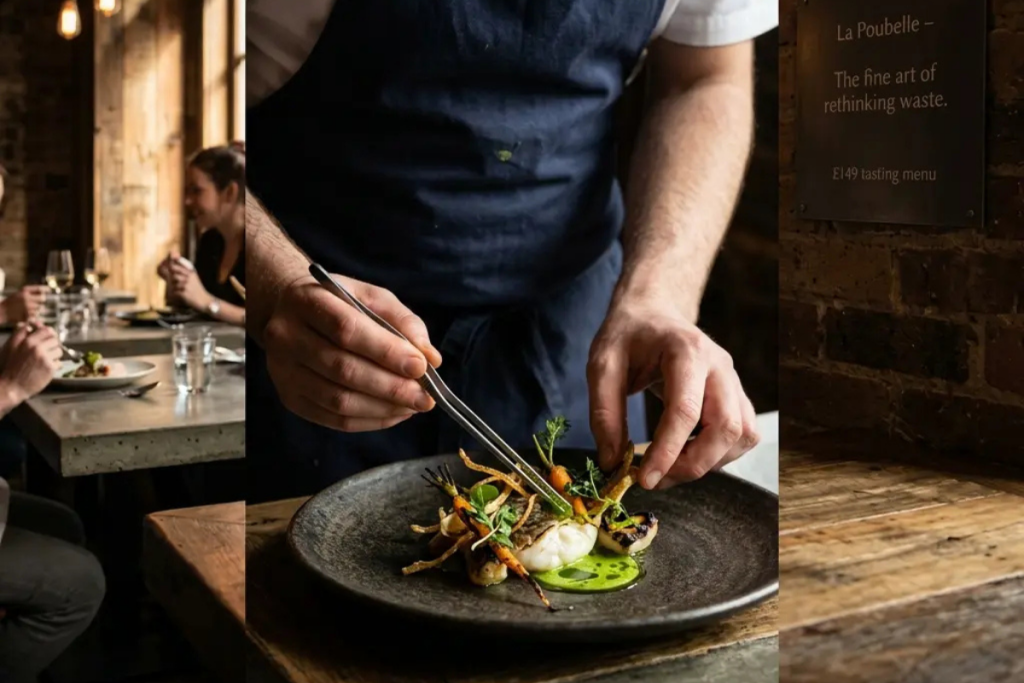
The waiter placed a dish in front of me: caramelized carrot top pesto over hand-pulled pasta, finished with toasted pumpkin seeds that would’ve been scraped into the bin at any other restaurant.
It was delicious. Like, stupid delicious.
And it cost £149.
Before I visited La Poubelle, I had the same reaction you’re probably having right now: they’re charging HOW MUCH for garbage?
But La Poubelle isn’t about trash. It’s about exposing the biggest lie we tell ourselves about value, quality, and what deserves to exist.
The name literally means “the trash can” in French. Seven courses made almost entirely from food destined for the bin. And I spent months obsessing over it before I finally went.
The Numbers That Made Me Stop Scrolling
The UK throws away 10.2 million tonnes of food every single year.
10.2. Million. Tonnes.
6.1 million tonnes of that is perfectly edible food. Food that could have been eaten. Food that someone grew, harvested, transported, and prepared, only to end up in a landfill.
That edible waste alone is worth £17 billion annually. For context, that’s £250 per person or about £1,000 for a family of four just… thrown away.
The hospitality sector generates nearly 1 million tonnes of food waste. Restaurants buy food where 4-10% never reaches customers. Another 31-40% of the served food doesn’t get consumed.
These numbers reveal something most of us never think about: waste isn’t a property of the food itself. It’s a decision we make.
When InSinkErator Opens a Restaurant, You Should Pay Attention
La Poubelle opened in Shoreditch in March 2026, backed by InSinkErator. Yes, the garbage disposal company.
A company that makes money from waste disposal decided the better move was to stop the waste from happening in the first place.
This wasn’t some feel-good PR stunt. This was a waste management company looking at the numbers and realizing there’s more value in transformation than disposal.
The restaurant uses classic French techniques (nose-to-tail, root-to-stem cooking) to transform ingredients most chefs toss without a second thought. Vegetable peels. Fish bones. Meat scraps. The stems everyone cuts off. The “ugly” produce that’s too big, too small, or too weird-looking to make it to grocery store shelves.
Course three was a revelation: slow-braised beef cheek (the cut most butchers throw away or sell for pennies) with a sauce made from vegetable trimmings, served over crispy potato skins. The kind of potato skins you peel off and toss without thinking.
Every bite made me angrier at myself. Every meal I’d thoughtlessly prepared. Every carrot top I’d composted. Every “ugly” apple I’d passed over at the grocery store.
How much had I wasted without even thinking about it?
More than 40% of UK fruits and vegetables get rejected before they even reach stores because they don’t look right. Not because they taste bad. Not because they’re less nutritious.
Because they’re not pretty enough.
Let that sink in.
La Poubelle takes that rejected produce and turns it into a £149 experience.
Why People Actually Pay £149 for “Trash.”
You’d think a restaurant serving discarded ingredients would discount heavily to convince people to try it. Maybe offer a £30 “sustainable dining experience” to ease people in.
La Poubelle did the opposite. They priced it like a luxury experience because that’s what it is.
The transformation from “waste” to “exceptional dining” doesn’t happen by accident. It requires skill, technique, creativity, and expertise. The same expertise that makes any fine dining experience worth paying for.
And people are absolutely willing to pay for it.
Research shows consumers will pay an average 20% premium for environmentally sustainable meals. Millennials? 36% will pay over 20% more. Gen Z? 50%.
It’s not just about sustainability virtue signaling, either. 67% of consumers say efficient food waste management is the most important sustainable practice a restaurant can implement.
People aren’t paying for trash. They’re paying for proof that the system can work differently.
(And okay, they’re also paying because the food is legitimately incredible. The fish collar with charred broccoli stems? I still think about it.)
The French Technique That Changes Everything
Technique transforms perception.
Take the same ingredient. Hand it to an amateur cook, and you get something forgettable. Hand it to a trained chef, and you get something worth remembering.
La Poubelle roots its entire concept in French culinary tradition, not by accident, but by design. French cuisine carries cultural weight. It signals refinement, expertise, and mastery.
When you say “we’re using nose-to-tail cooking and classical French techniques,” you’re not just describing a method. You’re borrowing centuries of credibility.
The biggest barrier to waste-to-value models isn’t the food—it’s the perception.
Most people hear “food waste” and think of something spoiled, contaminated, or inferior. They don’t think of carrot tops, fish collars, or perfectly good apples that were slightly too small for the grocery store’s standards.
The technique bridges that gap. It takes something people would instinctively reject and transforms it into something they’ll pay £149 to experience.
What This Means for Everything Else
La Poubelle represents something way bigger than one restaurant: “waste” is mostly a story we tell ourselves.
We decide what has value based on completely arbitrary standards: how it looks, where it came from, what mental box we’ve shoved it into.
But value? Value is created through transformation, skill, and context.
Think about what this means for other industries:
Fashion: “Deadstock” fabric that would otherwise be destroyed becomes limited-edition collections.
Manufacturing: Industrial byproducts that used to be disposed of become raw materials for new product lines.
Construction: Demolition waste that fills landfills becomes reclaimed materials that sell at premium prices.
The pattern is the same: someone looks at what everyone else calls waste and sees untapped value.
The Part Nobody Talks About (But Should)
La Poubelle works because it’s positioned as a luxury. The high price point isn’t a bug. It’s the entire strategy.
If they’d opened as a budget-friendly “sustainable option,” people would assume the food was lower quality. They’d think they were making some noble sacrifice for the planet.
By pricing it at £149, they’re making a different statement: This isn’t a compromise. This is an upgrade.
The luxury positioning creates permission for other restaurants to follow. When a high-end establishment proves that waste-to-value works, it signals to the industry that this is viable.
It’s already happening. More restaurants are experimenting with root-to-stem cooking. More chefs are finding creative uses for ingredients they used to throw away. More consumers are asking where their food comes from and where it goes.
💡 The real innovation isn’t the cooking technique. It’s the business model that makes waste more valuable than disposal.
What I’m Watching For Next
La Poubelle opened in March 2026. I’m writing this shortly after, which means we’re still in the early days of seeing how this plays out.
But here’s what I’m paying attention to:
Supply chain disruption: If more restaurants start competing for “waste” ingredients, does that create a new market? Do farmers and suppliers start intentionally producing “surplus” because there’s now demand for it?
Regulatory pressure: When a waste disposal company proves they can prevent waste instead of just processing it, does that change expectations for the entire industry?
Consumer education: Does dining at La Poubelle change how people think about food waste in their own homes? Do they start seeing value in vegetable scraps and “ugly” produce they used to toss?
Luxury market transformation: Does this shift how we define luxury from scarcity-based (rare ingredients, exclusive access) to transformation-based (skill, technique, creativity)?
My prediction? We’ll see supply chain disruption first—farmers and distributors will start marketing “waste” as a premium category. Then, regulatory pressure will mount, especially on waste management companies. But the biggest shift will be in how we define luxury itself: from scarcity to transformation.
I could be completely wrong. But my gut says La Poubelle just cracked open a door that won’t close.
Why This Matters for You
You might be thinking: “Cool story, but I’m not opening a zero-waste restaurant.”
Fair. But the principles still apply to whatever you’re working on.
Look at what you’re throwing away, literally or metaphorically. What are you discarding because it doesn’t fit your current definition of valuable?
What “waste” in your industry could be transformed with the right technique or positioning?
What arbitrary standards are you following because “that’s how it’s always been done”?
La Poubelle proves that value isn’t about the raw material. It’s about what you do with it.
The carrot top isn’t trash or treasure on its own. It becomes one or the other based on who’s holding it and what they know how to do with it.
That’s true for food. It’s true for business. It’s probably true for whatever you’re working on right now.
The Real Lesson
This whole thing is about the stories we tell about value. The arbitrary lines we draw between “worth keeping” and “trash.” The assumptions we don’t even realize we’re making.
La Poubelle succeeds because it challenges those stories with something undeniable: exceptional food that happens to be made from ingredients you would have thrown away.
The technique is impressive. The business model is clever. The environmental impact is meaningful.
But the real breakthrough is simpler: they proved that waste is a choice, not a category.
And once you see that, you can’t unsee it.
You start noticing waste everywhere—not just in restaurants, but in how you work, what you buy, what you assume has value, and what doesn’t.
You start asking better questions: What am I discarding that someone else would pay for? What am I overlooking because it doesn’t fit my current definition of valuable?
The UK throws away 10.2 million tonnes of food every year. La Poubelle isn’t going to solve that problem alone.
But it proves the problem is solvable.
What You Can Actually Do About This
Look, I’m not going to tell you to start making carrot top pesto (though honestly, you should. It’s weirdly good).
But here’s what I am going to suggest:
Next time you’re about to toss vegetable scraps, stop. Really look at what you’re throwing away. Those broccoli stems? They’re just as edible as the florets. Those beet greens? They cook up like chard. Those herb stems? They’re packed with flavor.
Buy the ugly produce. That wonky carrot tastes exactly like the pretty one. That too-small apple is just as sweet. Every time you choose “ugly” produce, you’re voting against the arbitrary beauty standards that waste 40% of perfectly good food.
Ask your local restaurants what they do with food waste. The ones doing interesting things will be excited to tell you. The ones who aren’t… well, now they know someone’s paying attention.
Challenge your own definitions of waste. Not just in your kitchen, but in your work, your projects, your life. What are you discarding because it doesn’t fit your current system? What could you transform instead?
La Poubelle is one restaurant making seven courses a night. You’re one person making decisions every single day about what has value and what doesn’t.
Those decisions add up.
And once you realize that waste is a choice? You can’t help but start choosing differently.
