
Metro Vancouver invests significant resources every year trying to convince you to compost your banana peels, skip the plastic bags, and think twice before tossing that sweater.
The question I kept asking: Does any of it work?
I dug into the data, the behavioral science, and the reality behind those cheerful mascots and billboards. Some campaigns achieve remarkable results. Others barely move the needle. The difference comes down to something most people overlook.
The Numbers Tell Two Stories
Metro Vancouver leads North America with a 65% waste diversion rate. That’s double the Canadian average of 28%.
Here’s the problem: that rate has been stuck between 63% and 64% since 2015. For nearly a decade, despite campaigns, bans, and public investment, the diversion rate plateaued.
The region aimed for 80% by 2020. They missed it. Now the goal is 80% within 25 years, with a more realistic short-term target of 65%.
If awareness campaigns work, why did progress stall?
The Food Scraps Success Story
Let me show you what actually worked.
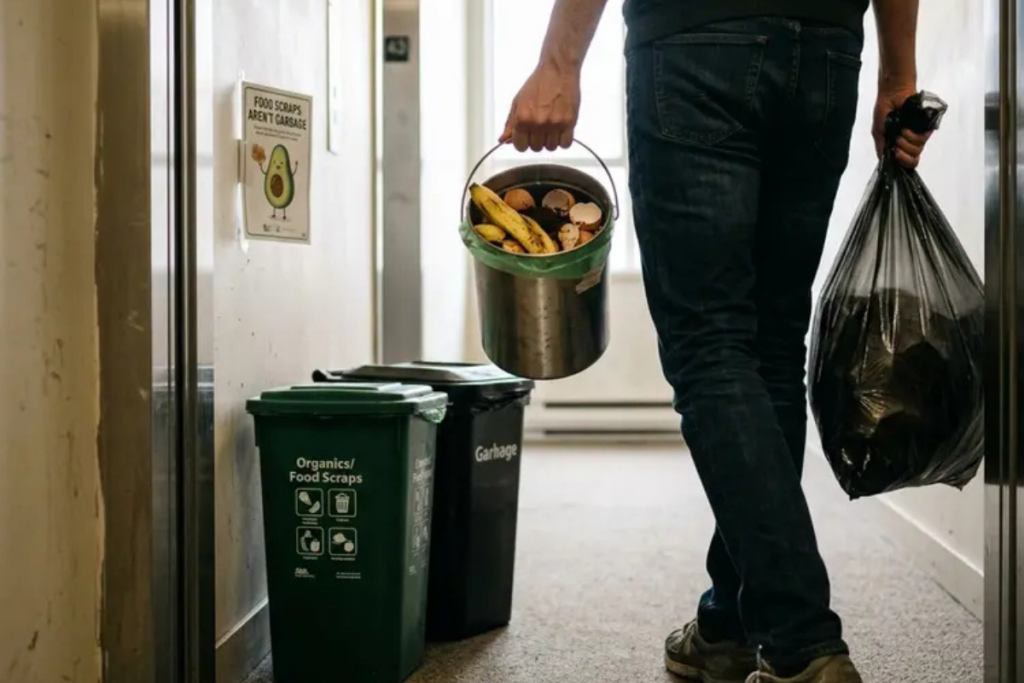
In 2015, Metro Vancouver banned organics from landfills. They launched the “Food Scraps Aren’t Garbage” campaign to support the ban. The campaign featured relatable characters like Mr. Avocado Shell and used simple, clear messaging.
The results:
-
Over 400,000 tonnes of food scraps diverted annually
-
400,000 tonnes of food scraps diverted in 2024 alone
-
160,000 tonnes of greenhouse gas emissions prevented in 2024 (equivalent to taking 50,000 cars off the road)
-
Since 2015, approximately 1.6 million tonnes of organics diverted through 2018
The campaign’s success is evident in its sustained impact over nearly a decade.
Why it succeeded:
Everyone eats. Everyone produces food waste. The behavior change required was simple: put scraps in a different bin. No moral dilemmas. No lifestyle overhaul. Just a small habit shift.
Compare that to asking people to change their diet or give up fast fashion. Those involve identity, values, religion, economics. Food scraps? Low friction. High relatability.
The Stubborn Reality of Convenience
Here’s where theory meets reality.
Despite a ten year ban on organics in landfills, food scraps remain the number one item in Metro Vancouver’s garbage at 22% of regional waste. In 2024, an average of 70 kilograms of compostable materials per person ended up in the trash.
That’s down from 87 kilograms in 2021, so progress is happening. But it’s slow. Really slow.
The barrier? Convenience.
Richmond’s waste coordinator identified “a lack of convenience” as the primary obstacle. Picture this: you’re in a high-rise apartment. You separate your food scraps into a container. It starts to smell. Now you need to carry it down three floors to the bin room. Compare that to just tossing everything in the garbage chute outside your door.
In multi-family buildings, 32% of waste is compostable organics, compared to the regional average. Smaller spaces, smell concerns, and the sheer distance between sorting and disposal create friction.
People want to do the right thing. But when doing the wrong thing is easier, most choose easy.
This pattern shows up everywhere. Research on waste management found that providing reusable containers was more effective than incentivizing people to bring containers from home. The strategy that makes it easier wins.
So when I looked at the behavioral science behind these campaigns, I wanted to know: what actually moves people?
What Behavioral Science Reveals
I spoke with researchers and reviewed the academic literature on behavior change. The patterns are clear:
Social conformity drives adoption more than individual conviction.
People change behavior when they perceive it as a social norm, not a personal moral choice. The more individuals who adopt a practice, the more likely others will follow to fit in.
Simple reminders that “most people recycle” increased recycling rates by 5% in Amsterdam. Personalized feedback led to a 23% reduction in contamination rates. Seven types of nudging techniques show positive effects, with the majority demonstrating great potential to influence pro-environmental behavior.
Education and campaigns achieve measurable results.
A meta analysis of over a million samples found that education and awareness campaigns produced meaningful behavior changes, primarily because they tap into social pressure. When everyone around you is doing something, you’re more likely to join in. System level interventions (like city wide campaigns) beat individual nudges every time.
But measurement remains challenging.
Nearly half of behavioral intervention studies on plastic waste were classified as having moderate to high risk of bias. Lack of precision in reporting limits confidence in documented findings. Many waste reduction initiatives are already underway, but few are implemented in ways that support rigorous impact evaluation.
Translation: We know campaigns work. Proving how well is harder than it looks.
The Fast Fashion Contradiction
Metro Vancouver’s “Super Habits” campaign launched in 2020 to tackle fast fashion and single use items. The messaging shifted from shame to celebration: bring your reusable cup, your bags, your containers.
The campaign uses both positive reinforcement (celebrating sustainable choices) and negative consequences (showing environmental damage from waste).
But here’s the reality check: clothing and textile waste remains a significant challenge in Metro Vancouver landfills.
People know fast fashion harms the environment. They see the campaigns. They nod along.
They buy it anyway.
Why? A $10 shirt is accessible to someone on a tight budget. A $60 sustainable alternative is not. This isn’t about awareness. It’s about economics. You can’t behavior-change your way out of systemic affordability issues.
The convenience economy undermines environmental progress. The pandemic accelerated disposable item use with masks, takeaway containers, and delivery packaging. Whenever convenience gains advantage, sustainability loses ground.
What I Learned About Behavior Change Timelines
David Hardisty, a behavioral scientist at UBC, told reporters that behavioral change operates on extended timelines. Early adopters champion practices, but mass adoption requires sustained effort over many years, not months.
This applies to any behavioral shift: sustainability, health habits, all of it.
The 65% plateau signals something: traditional awareness campaigns hit their ceiling. The remaining 15% to reach 80% will require different strategies. Regulatory measures. Economic incentives. But not just more mascots and billboards.
The Measurement Problem
Metro Vancouver reduced waste per capita by 24% since 2011. That’s more meaningful than diversion rates because it indicates actual consumption pattern changes, not just better sorting.
But proving that campaigns caused this reduction? That’s where it gets complicated.
Multiple variables influence outcomes. Economic conditions. Population changes. Infrastructure improvements. Policy shifts. Separating the impact of awareness campaigns from everything else requires rigorous evaluation methods that most initiatives lack.
The newer campaigns’ effectiveness “will take time” to analyze. That’s honest. It’s also frustrating when you’re trying to justify continued investment.
What Actually Works
Based on the data and research, here’s what matters:
Relatability determines success. The Food Scraps campaign achieved widespread adoption because it addressed a universal, low-friction behavior. Everyone eats. Everyone produces food waste. The ask was simple.
Make it easier, not just better. Convenience beats conviction. Providing reusable containers outperforms asking people to bring their own. The strategy that reduces friction wins.
Social norms influence more than facts. Showing that “most people compost” is more effective than explaining environmental benefits. People want to fit in.
Combine positive and negative messaging. Celebrating desired behaviors while depicting consequences of inaction creates a more effective framework than either approach alone.
Measure what matters. Waste per capita reveals consumption changes. Diversion rates reveal sorting behavior. Both matter, but they tell different stories.
The Bottom Line
The Food Scraps campaign achieved widespread adoption and diverted 1.6 million tonnes of waste because it was simple, universal, and low-friction. The fast fashion campaign struggles because no amount of awareness overcomes a $50 price gap when you’re on a budget.
Metro Vancouver’s investment in public awareness works when campaigns align with how humans actually behave: make it easy, make it social, make it feel normal. Where campaigns ignore these principles, progress stalls.
The remaining 15% to reach the 80% diversion goal won’t come from more billboards. It’ll require infrastructure changes that eliminate friction in multi-family buildings, economic policies that make sustainable choices affordable, and regulations that don’t rely on individual willpower.
That’s not a failure of behavioral science. That’s behavioral science telling us exactly where awareness ends and systemic change needs to begin.
