
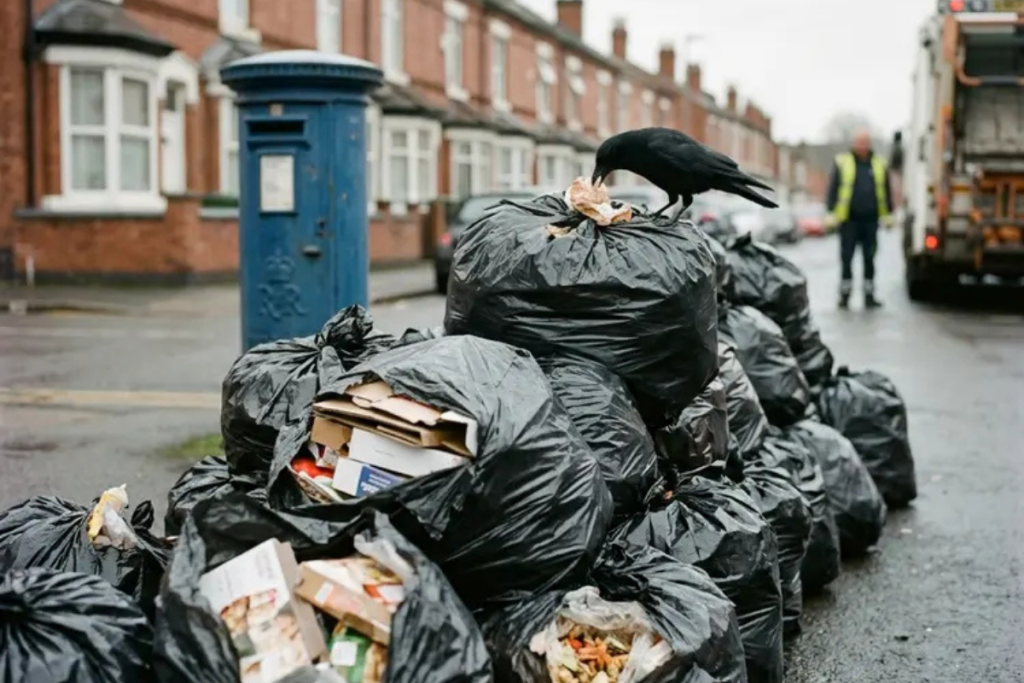
Over 400,000 Birmingham residents went without recycling collection for 15 months. Around 17,000 tonnes of waste piled up in streets before the government declared a “major incident.” Rats “as big as cats” roamed refuse mountains visible from space.
I’ve spent years writing about waste reduction and urban sustainability, celebrating cities that hit recycling targets. But Birmingham’s bin strike just taught me something uncomfortable: we’ve been building our sustainable cities on a foundation that was always going to collapse.
The strike ended this month with a tentative agreement between Birmingham City Council and Unite union. Over 400,000 residents went without recycling collection. Around 17,000 tonnes of waste accumulated before emergency intervention.
And here’s what makes this story different from every other labor dispute you’ve read about: this wasn’t really about waste collection at all.
The £1.1 Billion Bill That Broke a City
Birmingham City Council has paid approximately £1.1 billion in equal-pay settlements over the past decade. The council initially claimed it still owed £760 million, a figure later revealed to be a massive overestimate, with the actual settlement around £250-300 million.
That money went to women who worked as cleaners, cooks, and care staff. Women who were denied bonuses worth up to 160% of their basic salaries. Bonuses that male staff doing equivalent work received without question.
The council’s solution? Eliminate the waste recycling and collection officer role. Cut £8,000 from hundreds of workers’ annual pay. Transfer the cost of correcting historical discrimination onto today’s workforce.
See the problem?
The workers said no. They walked out in January 2025. By March, they’d escalated to an all-out strike. And Birmingham’s celebrated recycling program ground to a halt.
When Sustainability Meets Reality
The waste didn’t pile up evenly. Lower-income areas like Sparkhill, Balsall Heath, and Small Heath suffered disproportionately compared to affluent suburbs like Harborne and Edgbaston. The same pattern played out in the city’s 2017 bin strike.
Residents reported seeing rats “as big as cats” in the refuse. Mountains of garbage became visible from space. Black bags littered sidewalks with contents spilling from holes chewed by animals.
This is what happens when sustainability depends on underpaid, undervalued workers.
Your recycling program means nothing if the people collecting your carefully sorted bottles and cans can’t afford to live in the city they serve. Your circular economy goals collapse the moment those workers decide they’ve had enough.
The Math That Doesn’t Add Up
The financial insanity is staggering.
The strike cost Birmingham City Council £33.4 million as of January 2026. Unite research estimated the daily cost at £65,750.
Financial analysis showed the council spent more fighting the dispute than it would have cost to settle the underlying issue. They chose a 15-month standoff that devastated public health and environmental progress over addressing the pay structure that caused the problem.
Think about that. A city that claimed it faced a £760 million equal-pay bill (later proven to be vastly inflated) decided the best path forward was creating a new pay dispute that would cost tens of millions to maintain.
This isn’t financial management. This is institutional denial.
What Birmingham Reveals About Every City
Birmingham isn’t unique. The UK’s National Audit Office reported that 42 cities and towns required extra national support just to stay afloat in the fiscal year. Government funding to local authorities in England dropped by more than 50% between 2010-11 and 2020-21.
Several other councils have declared themselves effectively bankrupt in recent months. Croydon. Woking. Others will follow.
And every single one of these municipalities has ambitious sustainability targets. Carbon neutrality by 2030. Zero waste to landfill by 2035. Circular economy transformation.
You can’t build a sustainable city on an unsustainable economic model.
You can’t ask workers to subsidize your environmental goals with pay cuts. You can’t correct decades of wage discrimination by creating new wage discrimination. You can’t achieve zero waste when the people who collect your waste are one labor dispute away from walking out.
The Foundation We Ignored
I’ve realized something: we’ve been treating waste management as an environmental issue when it’s fundamentally a labor issue.
Every recycling bin you sort. Every composting program you participate in. Every circular economy initiative your city launches. All of it depends on people doing difficult, essential, often invisible work.
When those people are paid fairly and treated with respect, your sustainability infrastructure functions. When they’re not, it collapses. And no amount of green policy or environmental ambition can compensate for that fundamental instability.
Birmingham’s bin strike didn’t reveal a flaw in urban sustainability. It revealed that we built the entire concept on a flawed foundation. We separated environmental progress from economic justice. We acted like you could have one without the other.
You can’t.
What Actually Needs to Change
The Birmingham settlement came together about 10 days before local elections. Political survival accelerated compromise when operational and financial arguments failed for over a year.
That timing tells you everything you need to know about how cities prioritize essential services until political consequences force action.
If we’re serious about sustainable cities, this needs to change:
Stop treating equal-pay remediation as a cost to be minimized. Birmingham’s £1.1 billion in settlements represents decades of artificially suppressed labor costs. The city’s budget operated on financial fraud. Correcting that fraud isn’t optional, and the cost shouldn’t fall on current workers. A 15-year veteran waste collector earning £28,000 shouldn’t face an £8,000 pay cut because the council underpaid female cleaners for decades.
Recognize that environmental infrastructure depends on stable, fairly compensated workforces. Your recycling targets and waste reduction goals are meaningless if they collapse during the first labor dispute. Build workforce satisfaction into sustainability planning from the beginning.
Acknowledge that service disruptions in essential functions reveal emergency preparedness gaps. Birmingham lacked contingency planning for extended waste collection disruption. That vulnerability extends beyond labor disputes to natural disasters, pandemics, and infrastructure failures.
Understand that sustainability built on exploitation isn’t sustainable. If your environmental programs require underpaid workers, you don’t have a sustainability program. You have a time bomb.
The Question We Need to Answer
Birmingham’s waste crisis is over for now. The streets will be cleaned. The recycling program will resume. Politicians will claim victory or assign blame depending on their position.
But the fundamental question remains: Can you build a sustainable city on an unsustainable economic model?
I don’t think you can. Birmingham just proved it.
Every city with aggressive environmental targets needs to look at this strike and ask: Are we making the same mistake? Are our sustainability goals dependent on workers we’re undervaluing?
Because if the answer is yes, you’re just waiting for your own bin strike.
You’re just waiting for your own bin strike.
And when it comes, all those environmental achievements you celebrated will be buried under thousands of tonnes of uncollected waste, visible from space, a monument to the lie we told ourselves about what sustainability actually requires.
