
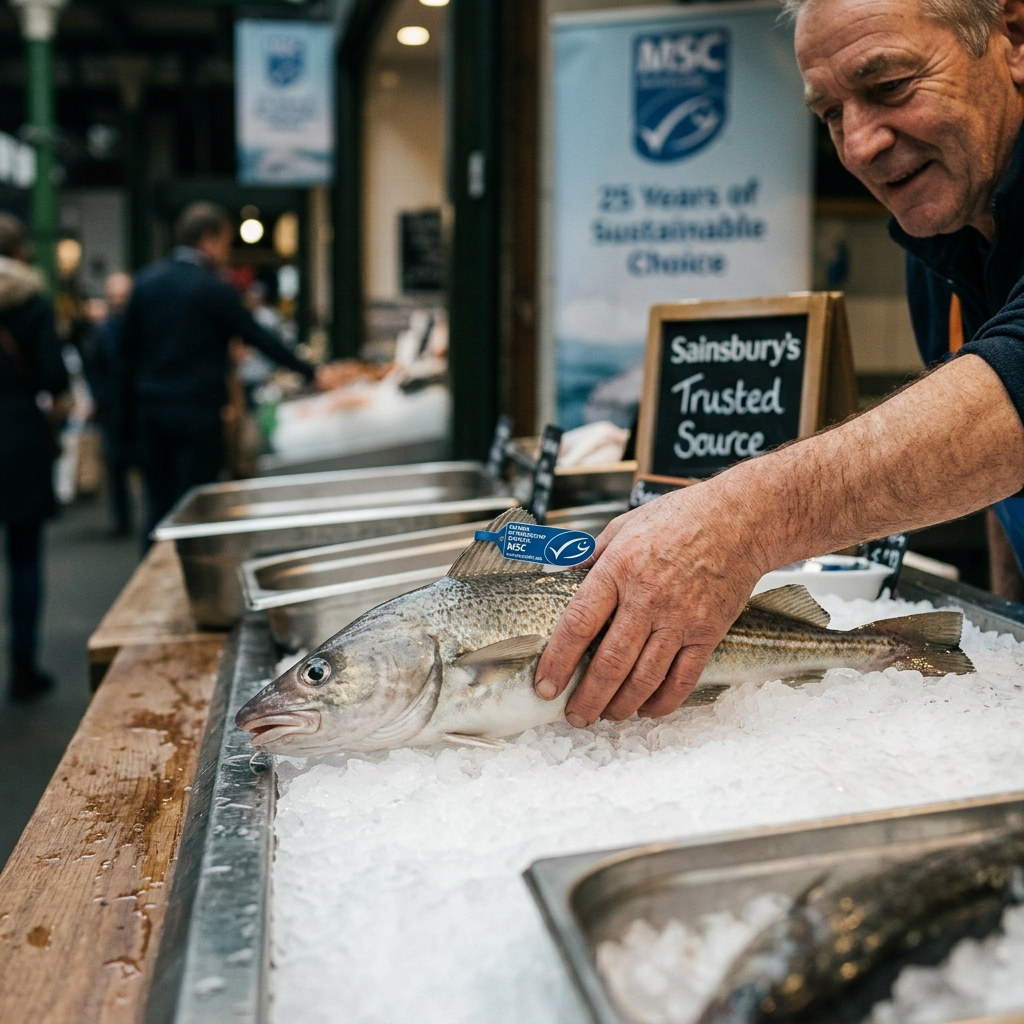
One product in 2000. £1.7 billion market today.
That’s not hype that’s what happens when a grocery chain actually commits to sustainability instead of just slapping green labels on things.
I’ve been tracking waste reduction for years, and Sainsbury’s did something in 2000 that most retailers still don’t understand: they launched the UK’s first Marine Stewardship Council (MSC) certified product. One single item: Thames red herring.
Twenty-five years later, that decision created a £1.7 billion market for certified sustainable seafood across the UK.
This isn’t a feel-good sustainability story. It’s how early adoption COMPOUNDS into market dominance.
The First-Mover Advantage That Actually Lasted
Most first-mover advantages disappear within years. Competitors catch up. The market normalizes. Early leaders lose their edge.
Not this time.
From that single product in 2000, they now stock 208 MSC-certified seafood products, more than any UK retailer. They’ve won the MSC Supermarket of the Year award eight times. Their certified range is 81% of their seafood offerings, the highest among UK competitors.
The difference? They didn’t just adopt a certification label. They rebuilt their supply chain around it and kept going for 25 years.
When you make sustainability an operational principle instead of a marketing add-on, the advantage compounds. Every supplier relationship you build around certified sourcing becomes harder for competitors to replicate. Every consumer you educate about that blue MSC label creates demand they’ll struggle to meet.
(And trust me, #beenThere with zero-waste products this pattern is EVERYWHERE once you see it.)
How Retailer Commitments Create Consumer Movements
Here’s what surprised me: consumers didn’t demand sustainable seafood first.
Retailers created the supply, normalized the option, and then consumer behavior shifted.
Today, 22% of UK customers say they won’t buy fish unless it’s sustainable. That’s not a niche preference anymore—it’s a purchasing requirement for nearly a quarter of the market.
But that conviction didn’t exist in 2000.
Sainsbury’s made certified options available, accessible, and NORMAL. They expanded from one product to 208. They put the blue ecolabel on everyday items like fish fingers and canned tuna, not just premium offerings.
The result? 88% of fish fingers sold in UK supermarkets now carry the MSC label. So do 80% of cod, cold-water prawns, and mussels.
Sustainability became the baseline expectation, not the premium choice.
This mirrors exactly what I’ve seen in zero-waste goods: when you make the sustainable option the default, adoption accelerates faster than any awareness campaign could dream of achieving.
The Upstream Revolution
Most sustainability stories focus on consumer impact. Fewer plastic bottles! Lower carbon footprints! Less waste!
But the REAL transformation? It happens upstream, in the supply chain.
George Clark, MSC Programme Director, said something that stuck with me: “When the fishing industry can rely on retailers that make the kinds of commitments we see here in the UK, to buy their sustainable catch, that’s when we see transformative positive change in our seas and across the globe.”
Purchase guarantees change producer behavior.
When a fishery knows a major retailer will buy their entire certified catch, they have the financial security to invest in certification. They’ll modify equipment to reduce bycatch. They’ll implement stock monitoring systems. They’ll adopt practices that might cost more upfront but secure long-term market access.
Sainsbury’s didn’t just buy certified seafood. They invested in Fishery Improvement Projects (FIPs) and pre-certification initiatives like Project UK, helping fisheries achieve certification before competing for already certified supply.
This approach, building future supply instead of competing for existing supply, creates different market power.
You’re not just a buyer. You’re a supply chain developer.
What Happens When Standards Become Requirements
Nearly two-thirds of wild-caught fish sold in UK supermarkets now carry MSC certification. UK retailers stock almost 1,000 certified products representing 49 individual species.
That’s not differentiation anymore. That’s table stakes.
When Sainsbury’s launched their first certified product, it was an advantage. Now, not having certified options is a disadvantage.
This shift from premium to baseline happens in every sustainability category. I’ve watched it with organic produce, recycled packaging, carbon-neutral shipping.
(Remember when “organic” meant specialty stores and 3x prices? Yeah. That changed.)
The pattern is consistent: early adopters establish the standard, consumers normalize around it, and late movers scramble to catch up.
What makes this case interesting is the speed. From £1.33 billion in consumer spending on MSC-certified seafood in 2023 to £1.7 billion in 2024-25—that’s not gradual adoption. That’s acceleration.
The Economic Resilience Test
Here’s the part that challenges conventional thinking: certified seafood sales grew during a cost-of-living crisis.
Let that sink in.
Two-thirds of the growth in MSC product spending in 2024-25 came from preserved products: cans, tins, jars. UK shoppers spent £339 million on these items, a 64% increase from the previous year.
When budgets tighten, conventional wisdom says consumers abandon premium options for cheaper alternatives. But sustainable seafood didn’t follow that script.
Why? Because Sainsbury’s and other retailers normalized certification across price points. You can buy certified canned tuna for the same price as non-certified. The sustainable option isn’t luxury it’s standard.
This reveals something important: when sustainable options match conventional prices, consumer values drive purchasing even during economic pressure.
The lesson applies way beyond seafood. In zero-waste products, the brands that succeed long-term don’t charge sustainability premiums. They achieve cost parity through scale, then let values-driven consumers choose them at equal prices.
(Looking at you, refillable shampoo bottles that somehow cost MORE than regular ones. That’s not how you win.)
Transparency as Competitive Pressure
Sainsbury’s publicly states their 81% certification rate alongside their goal of 100% sustainable sourcing.
That specificity matters.
Vague commitments create no accountability. “We’re committed to environmental responsibility” means nothing. “81% of our seafood is MSC-certified, and we’re working toward 100%” creates measurable pressure.
Competitors can track that number. Consumers can verify it. Media can report on progress or lack thereof.
Transparency makes greenwashing progressively harder.
I’ve noticed this trend accelerating. Companies that publish specific metrics carbon reduction percentages, waste diversion rates, certification coverage face different competitive dynamics than those making general claims.
Measurable commitments create races to the top. Vague commitments create races to the most convincing marketing.
The Diversification Strategy Hidden in Plain Sight
The 49 species represented in UK MSC-certified offerings isn’t random.
It’s a resilience strategy disguised as product variety.
When you source from dozens of fisheries across multiple species, you’re not dependent on any single stock. If one fishery faces challenges (climate impacts, regulatory changes, stock fluctuations), you have alternatives established.
This distributes environmental pressure across multiple sources instead of concentrating demand on a few popular species. (Because hammering cod stocks to oblivion is NOT sustainable, no matter how certified the fishing method is.)
It also protects retailers from supply chain disruptions that would devastate competitors relying on fewer sources.
Dave Parker, Sainsbury’s Aquaculture and Fisheries Manager, emphasized their commitment to supporting fisheries through certification and improvement projects. That’s not altruism—it’s supply chain security.
The more certified sources you develop, the more resilient your supply becomes.
The Blueprint for Any Industry
The Sainsbury’s-MSC partnership offers a template that works far beyond seafood.
First: Early adoption of credible third-party standards creates compounding advantages that last decades, not quarters.
Second: Retailer commitments can transform entire industries faster than regulation or consumer activism alone. When major buyers guarantee purchases of certified products, producers invest in certification.
Third: Normalizing sustainable options across price points (not positioning them as premium) accelerates mass adoption and proves resilient during economic downturns.
Fourth: Investing in supply development (helping producers achieve certification) creates more strategic value than competing for existing certified supply.
Fifth: Transparent, measurable commitments create accountability that vague sustainability claims can’t match.
I see these principles working right now in zero-waste goods, sustainable fashion, renewable energy, and regenerative agriculture. The specifics differ. The pattern holds.
The 25-Year Perspective
Most corporate sustainability initiatives operate on 3-5 year timelines. Long enough to show quarterly progress but too short to reshape markets.
Sainsbury’s maintained focus for 25 years.
That timeline allowed them to educate a generation of consumers, develop dozens of supplier relationships, establish operational expertise that competitors can’t quickly replicate, and normalize standards that are now industry requirements.
The advantage isn’t just that they started early. It’s that they stayed committed long enough for early decisions to compound into structural advantages.
In a business environment obsessed with quarterly earnings and rapid pivots, that kind of patience is RARE. It’s also what separates sustainability theater from actual transformation.
The £1.7 billion market for certified sustainable seafood didn’t appear overnight. It grew from one product, one retailer decision, and 25 years of consistent commitment.
That’s how you change an industry.
