
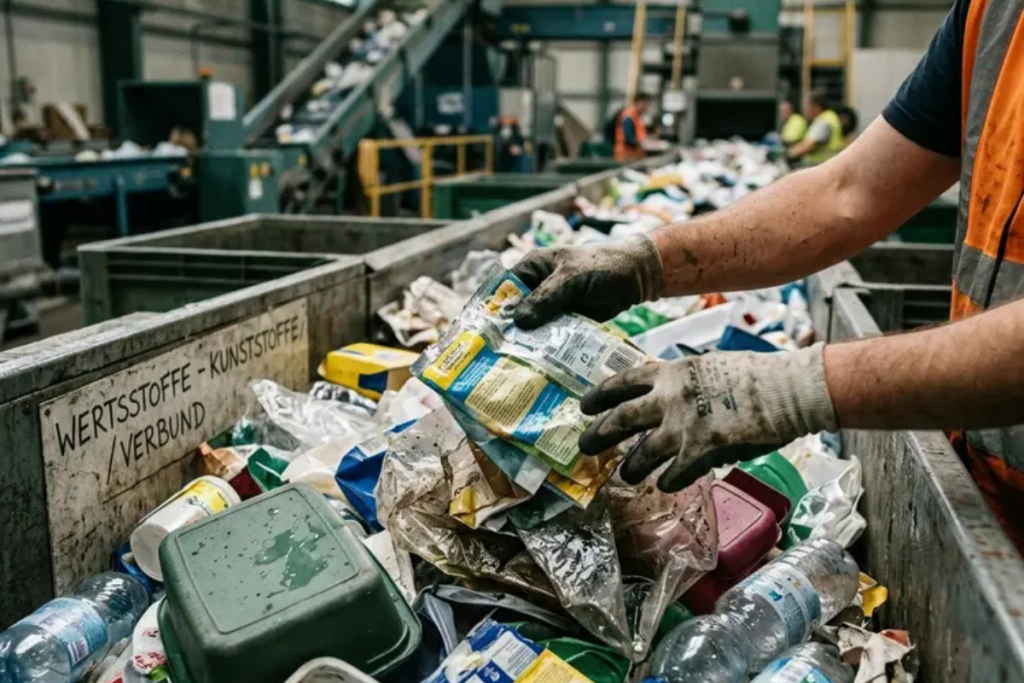
Victoria’s getting a fourth bin (purple-lidded, for glass). Australia’s recycling rate? Still stuck at 60%.
I’m for separating glass. But I’ve spent months looking at recycling systems around the world, and the same truth keeps surfacing: more bins don’t fix broken systems.
Australia’s recycling rate sits at 60%. It’s been stuck for years. We generate 2.88 tonnes of waste per person annually. Our circularity rate? 4.3%, lower than the global average of 6.9%.
What do the countries with high recycling rates actually do differently?
Kamikatsu: When Consumers Do Everything Right
Kamikatsu, Japan. Population: 1,500. They sort their waste into 45 different categories.
Forty-five categories.
They hit an 81% recycling rate in 2020.
Residents wash, dry, and manually separate everything. Bottle caps go in one bin. Labels in another. Clear PET bottles are separate from colored ones. The town cut waste generation by 65% from 2000 to 2020 and saved money by selling recyclable materials.
But the overall volume of waste hasn’t fallen in the past 10-15 years. It increased slightly.
Even with an 81% recycling rate, Kamikatsu still has 20% of waste it can’t process. The town admits that consumer efforts alone won’t eliminate that remaining fifth. They declared a new zero-waste plan focused on partnerships with businesses: they hit the ceiling of what households can do.
You can’t recycle your way out of overproduction.
Germany’s Secret Isn’t More Bins
Germany achieves a 98% return rate for single-use drink containers. Not through sorting. Through money.
Their Pfandsystem (deposit return scheme) charges €0.25 per container. You get it back when you return the bottle. Simple economic incentive. Massive behavioral shift.
This is separate from voluntary recycling that relies on goodwill and gets 40% participation on a good day. Germany’s PET bottle return rate sits above 97%.
But even Germany’s success reveals limitations. While they recycle 86% of plastic drink bottles, only 20% get converted into new bottles through horizontal recycling. The rest? Downcycled into lower-grade products.
Recycling often means degrading, not circulating.
So even the world’s best systems hit walls. Which brings us back home.
What Australia’s Plastic Problem Tells Us
Australia’s plastic recycling rate stalls at 13%. We generated 3.2 million tonnes of plastic waste in 2024. Only 423,000 tonnes got recycled.
We doubled our domestic reprocessing capacity to 600,000 tonnes in 2023-24. But we’re only using half of it.
Why? Limited feedstock. Labor shortages. Weak market demand for recycled material.
In New South Wales alone, we generated 891,000 tonnes of plastic waste in 2022-23. We recycled 14%. Our capacity to reprocess? 165,600 tonnes. That’s an 81% shortfall between what we produce and what we can handle.
Even with future planned capacity, we’ll still face a 54% shortfall.
The infrastructure exists. The materials exist. The market doesn’t.
The Four Things Missing from Recycling Debates
Effective recycling needs four things working simultaneously:
Products designed for recyclability. Not just technically recyclable—actually recyclable in existing systems with available markets.
Household separation systems. Bins, education, and cultural norms that make sorting automatic rather than confusing.
Processing infrastructure with capacity. Materials recovery facilities that can handle volume and maintain quality.
Viable markets for recycled materials. Buyers who choose recycled content over cheaper virgin materials.
Most recycling conversations focus on number two. We talk about bins and consumer behavior. We skip producer responsibility and market economics.
Adding a fourth bin addresses one element while leaving three systemic bottlenecks untouched.
Why South Australia Wins
South Australia achieves over 80% resource recovery. The Northern Territory sits at 19%.
South Australia pioneered container deposit schemes in 1977 (nearly 50 years to embed the behavior). Tasmania just joined in 2025.
This isn’t about infrastructure. It’s about generational behavioral change that takes 20-30 years.
Wales went from 5% municipal waste recycling in 1999 to 68% today. That’s two decades of sustained investment, education, and cultural shift.
Political cycles run 3-4 years. Meaningful recycling programs need 20-30 years to mature.
The Global Picture
Municipal solid waste generation will grow from 2.1 billion tonnes in 2023 to 3.8 billion tonnes by 2050. That’s an 81% increase in one generation.
In 2020, 38% of all municipal solid waste (810 million tonnes) was uncontrolled. Dumped in the environment or openly burned. If nothing changes, that figure doubles to 1.6 billion tonnes by 2050.
The direct cost of waste management globally? $252 billion in 2020. Factor in the hidden costs of pollution, poor health, and climate change from poor disposal practices, and it rises to $361 billion.
A fully implemented circular economy model could generate a net economic gain of $108.5 billion per year. We’re choosing the expensive, destructive path.
Turning Off the Tap
The Australian Marine Conservation Society advocates for “turning off the tap”: reducing production rather than optimizing disposal.
130,000 tonnes of plastic consumed in Australia end up in the marine environment each year. By 2025, an estimated 99% of seabirds will have ingested plastic.
Focusing exclusively on recycling plastic ignores pollution generated during extraction, production, transport, use, and disposal stages. The problem isn’t just what happens at the end. It’s what we made the thing in the first place.
More than 90% of plastics come from virgin fossil feedstocks. Recycled plastic uses 88% of the energy required to make new plastics, but we’re still choosing virgin materials because they’re cheaper.
The economics reward the wrong behavior.
The Packaging Complexity Problem
Modern packaging requires a degree in material science to understand.
Packaging uses multiple materials layered together. Some parts are recyclable, others are not. Labels that look identical have different compositions. Symbols that mean nothing are consistent across regions.
This complexity creates participation barriers. Limited education? Language proficiency? Cognitive capacity? You’re systematically excluded from “doing the right thing.”
We’ve optimized recycling systems for material purity while making them inaccessible to diverse populations.
Standardizing packaging formats would improve participation more than adding sorting categories. But that requires producer responsibility regulations, and those remain conveniently weak.
What I’m Doing Differently (Not Perfectly, Just Differently)
I still separate my waste and use the bins correctly (#beenThere, DoingThat). But I’ve stopped believing that’s where the solution lives.
I ask different questions when I shop:
Does this need to exist? Not “can I recycle it” but “does it need to be produced at all?”
Who designed this packaging? I’m tracking which brands create recyclable packaging and which create sorting nightmares.
What’s the local processing capacity? If my region can’t actually recycle it, the symbol on the package is decorative.
Is there a package-free option? Even if it costs slightly more or requires a minor inconvenience.
The UN Environment Programme emphasizes the waste hierarchy: prevention and reuse must precede recycling. With over 2 billion tonnes of municipal solid waste generated globally each year, upstream interventions deliver greater impact than downstream sorting.
I’ve shifted from perfecting my recycling technique to reducing what enters my home.
Zero Waste Goals Hit a Ceiling
Kamikatsu aimed for zero waste by 2020. They hit 80% and plateaued.
Wales declared zero waste by 2050. They’re at 68% and climbing, but the curve is flattening.
Even optimal systems face fundamental ceilings. Current production volumes, material complexity, and consumption patterns can’t achieve true circularity regardless of collection sophistication.
The asymptote in leading programs shows that incremental improvements in waste management can’t overcome underlying production and consumption structures.
What Needs to Change
Extended producer responsibility regulations that make manufacturers accountable for end-of-life management.
Economic structures that make recycled materials competitive with virgin materials through subsidies, taxes, or mandates.
Standardized packaging that reduces material types and eliminates sorting confusion.
Protected funding for recycling programs that operate outside political cycles.
Production limits that address volume at the source rather than managing consequences at disposal.
These changes require regulatory intervention, challenging industries that profit from current systems, and admitting that consumer behavior changes, while valuable, can’t solve production-level problems.
Victoria’s fourth bin might produce cleaner glass recycling. That’s good. But it won’t touch the 86% of waste we’re not addressing. It won’t challenge why we’re generating 2.88 tonnes per person annually. It won’t question whether we need all this stuff in the first place.
The Question I’m Asking Now
Not “how do I recycle this better?” but “why does this exist?”
The recycling narrative provides psychological permission for continued consumption. It suggests environmental problems are solvable through better waste management while production volumes remain unquestioned.
I’ve spent years perfecting my sorting technique, learning symbols, washing containers, and separating materials.
That effort matters. It’s not enough.
The real work happens before the bin. It happens when I choose not to buy. When I support brands using minimal packaging. When I demand regulatory changes that shift responsibility from consumers to producers.
Australia’s recycling rate will stay stuck at 60% until we address the systems that make waste inevitable. Adding bins treats symptoms. Reducing production treats causes.
Better sorting doesn’t solve overproduction. The fourth bin is fine, but it’s not the answer. The answer is making fewer things that need bins in the first place.
