
I’ve tracked telecom network expansion for years. The pattern rarely changes: operators build competing towers across the same geography, duplicate infrastructure costs spiral, and environmental impact compounds with each redundant installation.
Then the UK did something different.
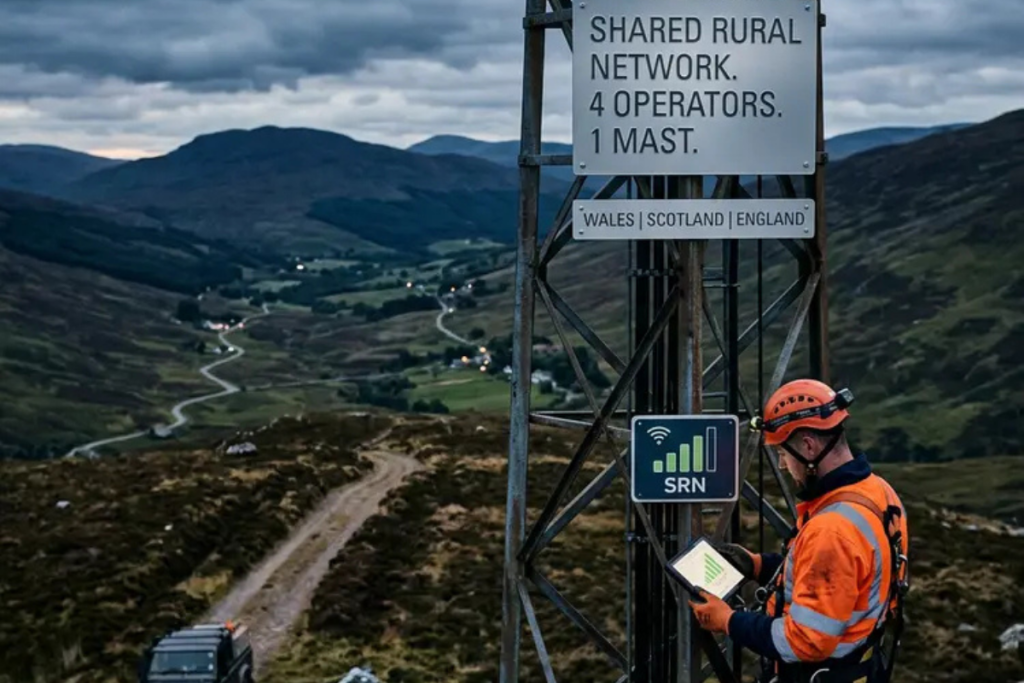
The Shared Rural Network program took existing emergency services infrastructure and converted it into multi-operator mobile sites. Instead of building new towers, they repurposed what existed. Instead of four operators constructing four separate networks, they shared one.
The results arrived faster than anyone predicted.
Nobody planned this as a revolution. The program started as a pragmatic solution to a coverage gap problem. Emergency services needed reliable networks. Rural communities needed better mobile service. The government had existing infrastructure doing one job that could do two.
The accident was realizing this approach worked better than the way telecoms had operated for decades.
The Numbers That Changed My Thinking
By February 2026, the program had activated 118 government-funded mast upgrades by repurposing existing Emergency Services Network infrastructure. Communities gained connectivity without new visual infrastructure or environmental disruption: 49 sites in Wales, 40 in Scotland, and 29 in England.
The program hit 96% geographic outdoor 4G coverage across the UK, a full year ahead of schedule. Coverage from all four operators increased from 66% to 81% since 2020: an expansion equivalent to Wales and Northern Ireland combined.
I had to read that twice.
That’s coverage expansion equivalent to 4.6 million football pitches, delivered through cooperation rather than competition. The program extended mobile coverage to 280,000 premises and 16,000 kilometers of UK roads.
The speed caught my attention. The efficiency kept it.
What Infrastructure Sharing Means
The traditional telecom expansion model: build your own infrastructure, control your own destiny, compete on coverage.
This creates predictable outcomes.
Four operators need coverage in the same rural area. Four operators build four towers within sight of each other. Four sets of construction crews disrupt the same communities. Four ongoing maintenance operations consume energy across redundant infrastructure.
The environmental math becomes brutal at scale.
Research from McKinsey confirms that network sharing can cut total telecom emissions by up to 10%, primarily Scope 3, while reducing materials use by more than 30%, while delivering the same network quality.
Same quality. 30% less material. 10% fewer emissions.
The Shared Rural Network program demonstrates this principle in practice. By converting single-operator sites into multi-operator infrastructure, the program eliminated the need for multiple competing towers across the same geography.
The environmental benefits compound beyond the physical infrastructure.
The Secondary Effects Nobody Talks About
Rural mobile coverage creates cascading sustainability advantages beyond the towers themselves.
Businesses digitize services. Teams conduct virtual meetings. Companies reduce business travel emissions. Digital infrastructure generates environmental returns through behavioral changes.
A rural business that required in-person meetings for client consultations can now operate virtually. The carbon savings from eliminating travel dwarf the emissions from the shared infrastructure that enabled the shift.
The telecom sector faces mounting pressure on this front. Without strategic intervention, the ICT sector could consume up to 20% of global energy by 2030. The wider ICT sector could be responsible for 14% of global carbon emissions by 2040, up from 3-4% today.
Infrastructure sharing becomes a business necessity.
The Economic Logic Behind Collaboration
The Shared Rural Network program involved over £500 million in government investment, with mobile operators contributing £532 million to address connectivity gaps.
That’s over £1 billion total to solve a problem that would have cost significantly more through competitive infrastructure.
The program targets “partial not spots”: areas where only some networks provide coverage. This creates a digital divide where connectivity depends on which operator you choose rather than where you live.
I’ve watched this dynamic play out across rural communities.
Two neighbors in the same village experience different digital realities based on carrier selection. One can run a remote business. The other can’t reliably make phone calls. Geographic proximity means nothing when infrastructure coverage varies by operator.
Shared infrastructure eliminates this arbitrary barrier.
The model also reshapes competitive dynamics in fundamental ways. Infrastructure sharing lowers entry barriers for rural expansion by reducing the capital required to enter new markets. Smaller operators can offer services through shared infrastructure without building their own networks.
Competition shifts from infrastructure-based to service-based differentiation.
Why Operators Resisted This Model
Infrastructure ownership has defined a competitive advantage in telecommunications since the industry began. Your network coverage was your moat. Sharing that infrastructure meant surrendering your primary differentiation.
The UK program required operators to abandon this logic. EE, Vodafone, Three, and O2 had to accept that their expensive rural infrastructure would serve competitors. The government investment and regulatory framework made the economics work, but the psychological shift was harder.
This model also creates dependency. When four operators share one tower, a single point of failure affects everyone. Maintenance coordination becomes complex. Service differentiation becomes harder when everyone uses the same physical infrastructure.
The tradeoff: lower capital costs and faster deployment versus reduced competitive control.
The Shared Rural Network program demonstrates a viable alternative to the duplicative network model that has defined telecommunications expansion for decades.
I see three major implications.
First, government-coordinated infrastructure sharing becomes standard practice globally. As environmental pressures intensify and duplicative networks become untenable, the UK model offers a blueprint for nations facing rural connectivity challenges.
Second, separating network ownership from service provision alters industry economics. When operators compete on service quality rather than infrastructure coverage, barriers to market entry decrease. This accelerates competition and innovation in ways that infrastructure-based competition prevented.
Third, proactive emphasis on sustainability indicates industry anticipation of stricter environmental regulations. Shared networks offer compliance advantages as carbon accounting becomes mandatory across telecommunications infrastructure.
The program reveals shifting priorities around rural-urban digital equity.
Why Rural Connectivity Drives Economic Competition
The focus on rural connectivity signals recognition that future economic competitiveness depends on geographically distributed opportunity rather than urban concentration.
Research shows broadband access enhances productivity, employment, and income, with stronger effects in areas near urban centers. Studies indicate a 1% increase in digital economy development correlates with a 0.47% improvement in urban-rural integration.
The relationship between connectivity and equity proves substantial but complex.
Digital infrastructure alone doesn’t guarantee economic development. The infrastructure creates possibilities, but communities must have the capacity and resources to capitalize on connectivity once it arrives.
Connectivity enables remote work, digital entrepreneurship, and access to distant markets. These opportunities require complementary investments in skills, business support, and local economic development to translate infrastructure into economic gains.
The Shared Rural Network program positions digital infrastructure as foundational to distributed work models. If connectivity barriers disappear, population movement away from urban centers accelerates as remote work becomes viable across broader geographies.
The Tourism Economy Connection
The program’s emphasis on connectivity in national parks reflects an understanding that modern tourism depends on digital infrastructure.
Connectivity in Eryri National Park and Bannau Brycheiniog National Park demonstrates this. Visitors expect reliable mobile service even in remote areas. Telecommunications infrastructure becomes essential for the tourism economy.
One shared tower serves four operators instead of four separate installations, minimizing visual and environmental impact.
The tourism economy increasingly depends on connectivity. A visitor center in Eryri can now process contactless payments reliably. Tour operators can communicate with guides in real-time. Hikers can call for emergency services from previously dead zones.
The infrastructure enables the economy without dominating the landscape.
What I’m Watching Next
The Shared Rural Network program hit coverage targets ahead of schedule. The model proved viable at scale. Environmental and economic benefits materialized as predicted.
The question becomes whether other nations adopt similar approaches.
I’m tracking several indicators:
Regulatory frameworks that incentivize or mandate infrastructure sharing. Policy will determine whether the UK model remains an exception or becomes standard practice.
Operator’s willingness to separate infrastructure ownership from service provision. This requires telecom companies to compete on different terms.
Environmental regulations that make duplicative infrastructure economically untenable. Carbon accounting requirements accelerate the adoption of shared infrastructure by making the cost of redundancy explicit.
Rural economic development outcomes in areas that gained connectivity through the program. Infrastructure creates opportunity, but measuring economic impact determines whether similar investments make sense elsewhere.
The telecommunications industry faces pressure to reduce environmental impact while expanding coverage to underserved areas. The Shared Rural Network program demonstrates that these objectives reinforce rather than conflict with each other.
The Broader Pattern
Infrastructure sharing in telecommunications mirrors trends across industries facing pressures around environmental impact and capital efficiency.
Energy grids, transportation networks, and water systems grapple with the tension between competitive service provision and shared infrastructure. The economic and environmental logic of avoiding duplication applies across these sectors.
The UK’s Shared Rural Network program offers a case study in how government coordination resolves collective action problems that markets struggle to address independently.
Four competing operators build four competing networks when left to market dynamics. Government coordination enables shared infrastructure that serves all operators while reducing environmental impact and capital requirements.
I expect to see this pattern repeated across other infrastructure sectors and geographies.
The efficiency gains are too substantial to ignore. Environmental benefits align with regulatory direction. The model demonstrates viability at scale.
The Shared Rural Network program represents the beginning of a broader shift in how nations approach infrastructure development across telecommunications and beyond.
The UK built a blueprint for sustainable infrastructure expansion, not through grand strategy but through practical problem-solving. The accident was discovering that collaboration worked better than competition for rural infrastructure.
I’m watching three markets closely: Australia faces similar rural connectivity challenges across a vast geography. The European Union is developing cross-border infrastructure sharing frameworks. India’s telecom consolidation creates opportunities for shared infrastructure models.
Each represents a different test case. Australia tests whether the model scales across extreme distances. Europe tests whether it works across regulatory borders. India tests whether it applies in high-density markets with different economies.
The UK proved the concept. The next decade determines whether it becomes standard practice or remains a unique experiment.
