
Between 2016 and 2022, only 42% of funded sustainable packaging companies secured follow-on investment.
I track these failures. Most happen quietly—promising material, enthusiastic early adopters, then silence when brands realize the premium costs 50% more than conventional packaging.
The rest hit a wall where their technology worked in labs but couldn’t compete in boardrooms.
Shellworks just broke that pattern.
The Cost Parity Moment Nobody Expected This Early
London-based Shellworks raised $15 million in Series A funding led by Alter Equity, with Nat Friedman and JamJar joining existing investors. The funding itself isn’t remarkable in a sector that’s seen billions.
What’s remarkable is when they achieved cost parity.
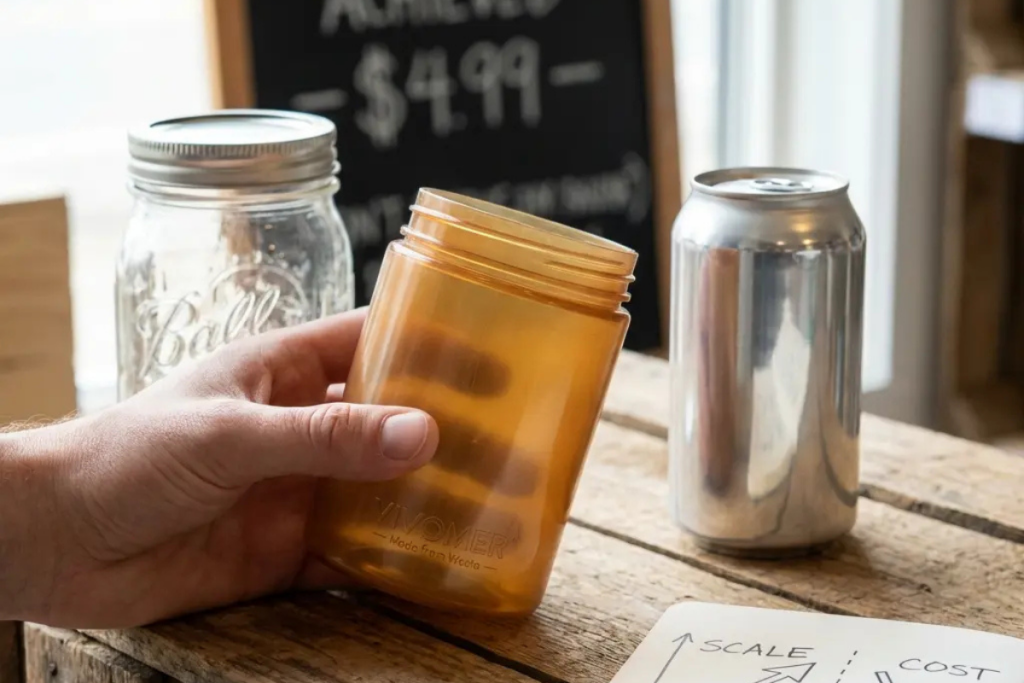
At just five million units annually, Shellworks’ Vivomer material matches the price of aluminum, glass, and paper. That production volume is microscopic compared to industrial-scale operations that process billions of units.
You need massive scale before sustainable alternatives compete on price. Shellworks reached price competitiveness while still small.
This tells me something fundamental shifted in their production process, not just scale. Cost parity at this volume shouldn’t be possible yet.
What Actually Makes Vivomer Different
Vivomer comes from microbial fermentation of waste cooking oil.
Here’s why that matters: 41–67 million tons of waste cooking oil are generated each year globally. Most of it ends up abandoned in sinks or landfills, creating environmental problems.
Shellworks takes that liability and feeds it to bacteria. Under specific conditions, these bacteria produce a biodegradable polymer that can be molded into rigid or flexible forms, matte or glossy finishes—basically matching whatever properties conventional plastic offers.
The material breaks down completely in a home compost within a year. No industrial facility required. Just water and CO2.
No fossil-based plastics. No BPA. No PFAS. No toxic additives.
But here’s what caught my attention: the feedstock flexibility. Waste cooking oil doesn’t require the pretreatment that limits other bioplastic approaches. Free fatty acids are metabolized directly by the bacteria.
You’re converting a disposal problem into a production asset.
The Consumer Behavior Gap That Kills Most Sustainable Products
I’ve watched this play out repeatedly: brands launch sustainable packaging, consumers express support, then purchase behavior shows the truth.
64% of Europeans want sustainable products. But only if they cost the same or less.
That gap between stated preference and actual behavior has buried countless sustainable packaging companies. They built for the 64% who said they cared, then discovered most people won’t pay extra at checkout.
37% of European consumers reduced plastic packaging use in 2025. That’s meaningful behavioral change. But it happened within economic constraints, not despite them.
The companies that survive understand this: you can’t ask consumers to sacrifice financially for environmental values at scale. The economics have to work without requiring virtue.
Shellworks was built for that reality.
Why Brand Partnerships Signal More Than Customer Validation
Shellworks secured partnerships with Wild (acquired by Unilever), Haeckels, Abel, Eclo, Hair by Sam McKnight, Wildsmith, and Pamela Anderson’s Sonsie Skin.
Wild’s presence at Tesco and Target matters more than the celebrity association.
Sustainable packaging used to signal premium positioning. Brands used it to differentiate in crowded markets, targeting consumers willing to pay more for environmental credentials.
That’s shifting. When Unilever acquires a sustainable brand and places it in mainstream retail channels, sustainable packaging becomes a baseline expectation rather than a premium feature.
The brands adopting Vivomer aren’t just early adopters chasing differentiation. They’re brands preparing for a market where sustainable packaging becomes the standard, and cost parity makes the transition economically neutral.
CEO Insiya Jafferjee put it directly: “The path to scale is execution, not speculation.”
The Infrastructure Play Nobody’s Talking About
Shellworks is establishing regional production facilities in Europe and the US.
This isn’t about geographic expansion. It’s about fundamentally different manufacturing infrastructure.
Microbial fermentation enables localized production using regional waste streams. You can set up facilities wherever waste cooking oil gets generated, rather than requiring massive centralized plants that ship globally.
The economics favor decentralization. Transportation costs and carbon emissions disappear while converting local waste into local products.
Traditional plastic manufacturing requires economies of scale to justify capital investment. Centralized facilities process enormous volumes to spread fixed costs.
Biological manufacturing operates differently. Smaller regional facilities become economically viable because the feedstock is local, the process is modular, and the transportation burden disappears.
Manufacturing infrastructure is shifting from industrial concentration to biological distribution.
What the Funding Collapse Reveals About Market Reality
Sustainable packaging funding dropped dramatically between 2023 and 2025. The 58% failure rate for follow-on investment isn’t about technology risk.
It’s about the gap between innovation cycles and procurement timelines.
Startups develop novel materials on 2-3 year cycles. Corporate procurement operates on 5-10 year cycles with extensive testing, supplier qualification, and risk assessment.
Most sustainable packaging companies run out of runway before brands finish evaluating them.
The companies that survive either achieve cost parity fast enough to accelerate procurement decisions or they fail before completing the evaluation process.
Shellworks reached cost parity while still small enough to iterate quickly. That’s the window where sustainable alternatives can displace conventional materials rather than remaining perpetual “alternatives.”
The Regulatory Pressure Building Beneath the Surface
Global plastic waste is projected to almost triple by 2060, rising from 353 million tonnes in 2019 to 1,014 million tonnes. Plastic leakage to the environment will double to 44 million tonnes annually.
Even with that explosive growth, recycling rates will only improve from 9% in 2019 to 17% in 2060.
Half of all plastic waste will still end up in landfills.
Those numbers create regulatory inevitability. Carbon pricing, extended producer responsibility, and plastic taxes are proliferating globally as governments realize recycling can’t solve the problem.
Companies with drop-in replacements at competitive prices will capture value as regulations make conventional plastic increasingly expensive.
The petrochemical industry faces a vulnerability window. Plastic production contributes 3.4% of global emissions while creating persistent environmental damage through microplastics in soil, water, and biological systems.
Companies that can offer economically equivalent alternatives before regulations force the transition will define the next generation of packaging materials.
What This Means for the Waste Economy
I’ve tracked zero-waste solutions long enough to recognize when something shifts from idealism to economics.
Shellworks represents that shift.
The company doesn’t ask consumers to pay more or brands to sacrifice margins for environmental values. It transforms waste streams into competitive materials using biological processes that work at a regional scale.
That’s what scales: solving multiple problems simultaneously rather than creating trade-offs.
Waste disposal becomes feedstock acquisition. Environmental impact becomes a competitive advantage. Sustainable packaging becomes economically obvious rather than aspirational.
If Shellworks maintains price parity while scaling regionally, the conventional packaging industry faces a replacement cycle faster than current forecasts predict. The brands that move first will set the pace. The ones that wait will be reacting to a market that’s already moved.
I’m watching to see who blinks first.
