
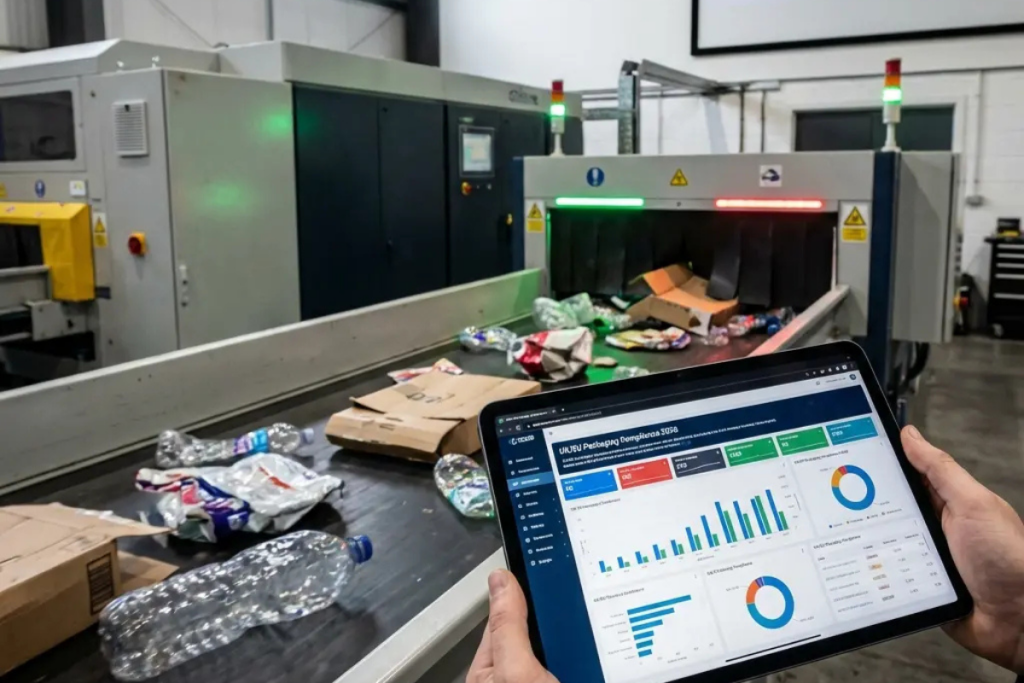
March 2026: Small producers must register for UK EPR. July 2026: Modulated EPR fees launch. Companies without recyclability assessments default to the highest cost tier—up to 50% more than compliant competitors.
The British Retail Consortium’s regulatory horizon scan isn’t theoretical. It maps the compliance deadlines, fee structures, and reporting requirements that hit in the next 18 months.
Packaging regulations moved from policy development to active enforcement. The financial and operational impact starts now.
Critical Deadlines: Your Compliance Calendar
2026 Timeline:
March: UK small producers must complete EPR registration
April: Small producers submit 2026 EPR data
July: EPR-modulated fees based on recyclability data go live
August: PFAS banned from packaging (EU); PPWR provisions take effect
Q3-Q4: First EPR invoices incorporating eco-modulated fees
2027 and Beyond:
April 2027: Plastic Packaging Tax recognizes chemical recycling
October 2027: UK DRS launches
January 2028: Design for Recyclability criteria (EU)
2030: All packaging must be recyclable (EU); 90% container collection target (UK); 50% empty space limits; recyclability performance grades
2038: Stricter recyclability obligations (EU)
EPR Fees Start Hitting in 2026
UK packaging EPR goes operational this year. Small producers must register by April. Modulated fee structures based on recyclability data launch in July.
What that means:
Packaging not assessed under the Recyclability Assessment Methodology (RAM) defaults to a Red rating. Red rating means escalating fees. Businesses that assess and improve packaging reduce costs by up to 50% compared to those using difficult-to-recycle materials.
This cost structure rewards better packaging decisions. The financial incentive is immediate and substantial.
First invoices with eco-modulated fees arrive second half of 2026. Penalty for non-compliance: up to 20% of unpaid fees or 5% of UK turnover for packaging. The real cost isn’t the penalty—it’s the competitive disadvantage against companies that moved faster.
You’re paying for positioning.
Deposit Return Schemes Finalize Design This April
The UK Deposit Return Scheme publishes final design specifications in April 2026. Implementation: October 2027.
UK consumers use around 14 billion plastic drinks bottles and nine billion cans annually. When customers buy a drink, they’ll pay around 20p extra. They get it back when they return the bottle or can. The goal is ambitious: collect and recycle 90% of containers by 2030.
DRS, along with other collection and packaging reforms, will support 21,000 new jobs and stimulate over £10 billion investment in recycling over the next decade.
The complexity: Wales includes glass bottles in its scheme, but initially without a deposit. England and Northern Ireland exclude glass. This creates compliance challenges for cross-border operations and distribution networks.
This means designing reverse logistics systems, consumer-facing infrastructure, and behavior modification strategies. The 2027 launch date isn’t far away.
Chemical Recycling Gets Recognition
The UK government is adapting the Plastic Packaging Tax to recognize chemical recycling through mass balance approaches. Implementation: April 1, 2027.
This creates new compliance pathways beyond traditional mechanical recycling. The UK’s first commercial-scale chemical recycling plant in Teesside is already diverting difficult-to-recycle plastic packaging from landfill and incineration.
Mass balance accounting tracks chemically recycled content through complex supply chains where physical separation isn’t practical. This regulatory recognition could unlock investment capital and accelerate technology deployment.
For hard-to-recycle plastics destined for incineration or landfill, this changes the economics. Chemical recycling becomes viable.
Sustainability Reporting Expands Into Scope 3
Proposed UK Sustainability Reporting Standards may mandate large listed companies to disclose climate-related risks, governance structures, and comprehensive emissions data. The expansion: scope 3 supply chain emissions.
This pushes transparency requirements beyond direct operational control into indirect value chain impacts. You need accurate data from suppliers and partners. You need collaboration mechanisms.
The EU’s Packaging and Packaging Waste Regulation (PPWR) reinforces this. Unlike the previous directive that member states could interpret individually, PPWR applies uniformly and directly in all 27 EU countries. Most provisions take effect August 12, 2026.
The regulation establishes recyclability performance grades from 2030 and stricter recyclability obligations from 2038. All packaging must be recyclable by 2030. Design for Recyclability criteria arrive in January 2028.
This requires data infrastructure that tracks material flows, validates sustainability claims, and reports across multiple regulatory frameworks simultaneously.
Green Claims Face Verification Requirements
The EU’s Empowering Consumers for the Green Transition Directive introduces stricter verification requirements for environmental claims. Unsubstantiated sustainability marketing is over.
You need documented evidence. Third-party validation. Proof for product-level environmental communications.
“Forever” chemicals (PFAS) will be banned from packaging on August 12, 2026. By 2030, grouped transport and e-commerce packaging can’t exceed 50% space (40% for e-commerce parcels from August 2026).
These are enforceable standards with specific timelines and measurable criteria.
What This Means for Your Operations
Early compliance creates a competitive advantage. Companies that exceed minimum standards gain enhanced brand credibility, reduced adaptation costs, and preferential positioning as regulations ratchet upward.
A capability gap is emerging.
Data infrastructure is a critical business infrastructure. EPR recyclability reporting, scope 3 emissions disclosure, digital product passports, and green claims verification all demand granular, verifiable sustainability data across extended supply chains.
Companies lacking robust data collection, validation, and reporting infrastructure face escalating compliance risks and operational bottlenecks. This is a fundamental business requirement.
Supply chain power dynamics are shifting. Extended reporting obligations transfer accountability pressure to material suppliers and packaging manufacturers. Retailers and brands leverage procurement power to demand verified sustainability data and improved material performance from suppliers.
This consolidates supplier relationships around those capable of meeting advanced transparency and performance standards.
The Circular Economy Business Model Shift
Who Wins, Who Loses
Winners:
Companies with established data infrastructure and sustainability reporting capabilities gain an immediate advantage. They can substantiate green claims, track recyclability metrics, and demonstrate scope 3 emissions reductions while competitors scramble to build baseline capabilities.
Material suppliers providing verified recycled content and recyclability data gain procurement leverage. As retailers face EPR fees and reporting requirements, they’ll consolidate purchases around suppliers who reduce compliance friction.
Chemical recycling technology companies see regulatory validation. Mass balance recognition in the Plastic Packaging Tax creates commercial viability for technologies previously considered experimental.
Third-party verification and data management platforms capitalize on the compliance gap. Companies lacking internal capabilities will outsource recyclability assessments, scope 3 emissions tracking, and green claims verification.
Losers:
Single-use packaging manufacturers face margin compression. EPR fees, DRS infrastructure costs, and minimum recycled content requirements squeeze profitability on traditional products. Those without pivot strategies toward reusable or highly recyclable alternatives face declining market share.
Small to mid-size retailers and manufacturers without resources for dual UK-EU compliance systems get squeezed. Regulatory divergence creates fixed costs that scale poorly for smaller operations.
Suppliers unable to provide verified sustainability data lose access to major retail accounts. As procurement power concentrates around transparency requirements, data gaps become deal-breakers.
Companies treating compliance as a minimum checkbox exercise fall behind. The gap between regulatory floor and competitive ceiling widens. Early movers capture brand credibility and operational efficiencies that create compounding advantages.
Regulatory emphasis on reusable packaging, minimum recycled content, and extended producer responsibility creates economic incentives favoring circular business models over linear approaches. The numbers back this up.
Reusable packaging models show commercial promise. Government focus on reusable and refillable models intensifies, with anticipated calls for evidence on reuse mechanisms in retail and hospitality sectors.
The policy architecture systematically erodes the cost advantages of virgin materials and single-use packaging. EPR fees penalize non-recyclable packaging. Plastic Packaging Tax adds £200 per tonne for materials with less than 30% recycled content. DRS shifts infrastructure costs to producers. Combined, these mechanisms make circular models economically favorable, not just environmentally preferable.
Successful implementation depends on significant consumer behavior change. This requires coordinated public education, infrastructure development, and incentive design. Regulatory frameworks recognize that systemic change requires consumer participation, not just producer compliance.
The UK-EU Divergence Challenge
Despite harmonization efforts, UK-EU regulatory divergence remains a risk. UK policy develops independently post-Brexit while maintaining trade relationships with EU markets.
Dual compliance systems may remain necessary indefinitely. This creates complexity and cost burdens that disadvantage smaller players lacking resources for parallel regulatory navigation.
Complexity compounds with jurisdictional differences like Wales, including glass in DR, S, while England and Northern Ireland exclude it. Cross-border operations require flexible compliance systems capable of meeting multiple jurisdictional requirements simultaneously.
What You Should Do Now
Get your RAM assessment done by June 2026. Contact your producer responsibility organization or hire an accredited assessor. Budget 4-8 weeks for assessment and potential packaging redesigns. Missing the July fee launch locks you into a Red rating for at least one reporting cycle.
Model your DRS infrastructure costs now. Calculate reverse logistics expenses: collection point installation, transportation networks, cleaning/processing facilities, and customer service systems. Scottish DRS (delayed but informative) showed infrastructure costs ranging from £80 to £250 per collection point. Pilot your return systems internally before the October 2027 mandate.
Run a data gap analysis this quarter. Map what sustainability data you can currently access versus what EPR, scope 3, and green claims regulations require. Identify supplier data gaps. Build collection systems into procurement contracts now. Companies starting data infrastructure builds in 2027 will be 12-18 months behind on required reporting.
Score your supplier based on compliance readiness. Create a matrix: Can they provide recyclability documentation? Verified recycled content percentages? Scope 3 emissions data? Response timelines to data requests? Suppliers scoring low on three or more criteria represent risk. Begin supplier consolidation or capability-building initiatives before Q4 2026.
Run circular model financial scenarios. Model reusable packaging economics against rising EPR fees, Plastic Packaging Tax, and DRS costs. Include Loop-style platform partnerships, in-house returnable systems, or refill station networks. Build business cases now while you have time to test and iterate. By 2028, you’ll be implementing under regulatory pressure instead of a strategic choice.
The Compliance Window Is Closing
July 2026’s fee launch is five months out. August 2026’s PPWR compliance deadline is six months away. October 2027’s DRS implementation is 20 months—that’s barely two budget cycles.
Companies treating this as a distant future policy are miscalculating. The businesses building data infrastructure, redesigning packaging, and piloting circular models right now are creating competitive moats that widen with every regulatory cycle.
The gap between early movers and late adopters isn’t just timing. It’s market position, procurement leverage, brand credibility, and operational cost structure.
We’re not all facing the same shift. We’re facing the same deadlines with vastly different levels of preparation. That difference determines who pays compliance costs and who profits from competitive advantage.
