
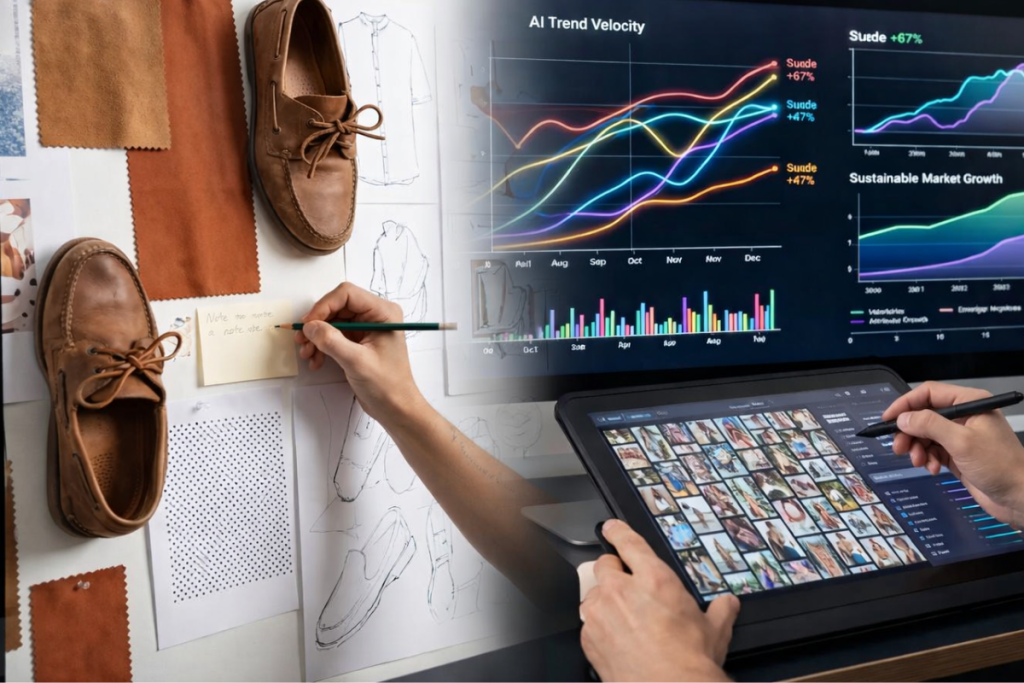
You’re making million-dollar inventory decisions based on what a handful of trend forecasters think will be hot next season. AI is analyzing millions of social media images daily, tracking 2,000+ fashion attributes, and predicting trends with 91% accuracy up to two years ahead.
The gap is where money gets wasted or made.
The Numbers That Changed Everything
Heuritech and Luxurynsight’s 2026 Trends Calendar replaced gut feelings with pattern recognition at scale.
Their 2025 predictions: Suede, boat shoes, and cinnamon exploded with growth between +17% and +87%. Dotted prints, flat-thong sandals, and yellow showed up on runways as predicted. WGSN’s TrendCurve AI hit 94% accuracy a year in advance.
What AI Sees That You Don’t
Traditional forecasting relies on runway analysis, street style photography, and expert intuition—hundreds of data points filtered through human bias.
AI processes millions of images across Instagram, TikTok, and Pinterest daily. It detects colors, prints, fabrics, silhouettes, and styling combinations before they hit critical mass. It tracks velocity—how fast a trend is moving and where it’s headed.
The methodology combines machine learning with human expertise. Models consider historical patterns, consumer behavior, and social signals to predict trend growth up to 24 months ahead. AI identifies the signal. Humans interpret the cultural context.
More than 40% of global consumers purchased apparel via social media at least three times in 2024. The platform is the trend source now. Elite fashion opinions carry weight, but the prediction game expanded.
Trends move faster because of social media. Your forecasting window shrank while your data volume exploded.
What’s Actually Trending in 2026
Sustainability Stopped Being Optional
The sustainable fashion market hit $9.65 billion in 2024 and is projected to reach $58.18 billion by 2033—a 22.1% annual growth rate. Here’s what matters: 68% of global consumers now consider sustainability a major purchasing factor. For millennials and Gen Z, 54% actively prioritize low-impact options when they shop.
You’ll see this in reworked classics, raw denim, and tartan making comebacks. But consumers aren’t just buying the aesthetic—they’re asking where materials came from and what happens to garments after they’re done with them. Answer those questions or lose the sale.
Texture Over Logo
Tactile experiences are replacing brand worship. Fur, leather, suede, and draping gain importance as the things people actually want to touch and feel. Volumetric silhouettes create a visual impact that photographs well and feels substantial in person.
Statement pieces drive purchase decisions because they do double duty: impressive in your closet, impressive on your feed.
Sports-inspired aesthetics continue bleeding into everything else. Comfort and functionality aren’t compromises anymore—they’re selling points.
The Colors and Prints That Perform
Gender-neutral palettes are expanding faster than gendered ones, which means your supply chain needs restructuring if you’re still segmenting inventory by traditional men’s/women’s categories.
Photogenic prints like large polka dots overperform because they photograph well. Social media visibility drives purchase intent, so you’re designing for content creation as much as for wear. If it doesn’t look good in a mirror selfie, it doesn’t sell.
On the flip side, structured minimalism balances the maximalist prints. The market fragments in both directions simultaneously, which means your inventory management needs to get significantly more sophisticated.
The Democratization Problem Nobody Talks About
AI-powered forecasting used to cost six figures and require dedicated data teams. Now it’s accessible to brands doing under $100 million annually.
The technology levels the playing field. Small brands get the same insights that were once reserved for luxury houses with massive research budgets.
“If you’re a small brand and there is an 800-pound gorilla that you need to run through for you to grow, this is your opportunity right now, and it is urgent.”
This disrupts traditional gatekeeping. It also potentially accelerates fast fashion. More players with better data means faster trend cycles and more production.
The sustainability gains from better forecasting (less overproduction, fewer markdowns) compete with the sustainability costs of faster trend turnover.
What This Means for Your Business
McKinsey estimates generative AI could boost operating profits in fashion by $150-275 billion within three to five years. That’s a fundamental restructuring of how value gets created.
The technology transforms design iteration, trend forecasting, inventory optimization, customer personalization, and supply chain coordination. Every touchpoint where you currently guess becomes a place where you can know.
AI can’t do fashion prediction alone. The human aspect remains essential. You need rigor and process. You need professionals who translate between data patterns and cultural narratives.
Francesca Muston, chief forecasting officer at WGSN, frames it clearly: “We can use AI to supercharge what we do. But you have to really start putting a lot of rigor and a lot of process into what you’re doing.”
The Integration Challenge
Your team needs new skills: data literacy, statistical thinking, and cultural interpretation that works with algorithmic insights instead of ignoring them.
You’re not replacing human judgment. You’re augmenting it with pattern recognition at a scale humans can’t match.
The brands winning this transition combine quantitative precision from data science with qualitative insights from industry expertise. The result is forecasts that are both accurate and actionable.
The Runway Economics Shift
Fashion weeks are content creation opportunities. Shows get designed for social media amplification. The economics change when the primary value is digital visibility rather than buyer orders.
AI tracks which runway moments gain traction, which silhouettes photograph well, and which styling choices generate engagement. The feedback loop tightens.
Trend prediction and trend creation converge. The forecast influences what gets shown. What gets shown influences what trends.
Where This Goes Next
Sustainability as baseline means brands either integrate it or face market resistance. The sustainable fashion sector is projected to grow from $9.65 billion in 2024 to $58.18 billion by 2033—a 22.1% annual growth rate that shows no signs of slowing.
Texture and tactile experience matter more as digital shopping grows. Consumers seek sensory differentiation, which means your product photography needs to communicate how things feel, not just how they look.
Market fragmentation increases across every dimension: gender-neutral trends, use-case specific color palettes, photogenic versus wearable design. Your SKU count goes up, or your market coverage goes down. There’s no middle path.
The brands that thrive will combine AI-powered forecasting with deep cultural understanding. They’ll use data to identify opportunities and human expertise to execute them with authenticity that actually resonates.
The question is how quickly you integrate AI forecasting and whether you build a team capable of using it well.
Your competitors are analyzing millions of social media images, tracking 2,000+ attributes, building systems that turn cultural observation into business advantage.
The fashion forecast got smarter. Match it.
