
You can recycle bike tires in Bexley, but not in Brent. Hackney takes foil, but Hammersmith doesn’t. Move three miles down the road, and suddenly your plastic film belongs in the trash instead of the recycling bin.
Among 321 local authorities, household recycling rates range from 15.8% to 62.9%. That’s a 47 percentage point gap based purely on where you live. Wales recycles 57% of household waste. England manages just 44%.
In April 2026, England adopts a single national standard.
The Four-Bin Mandate
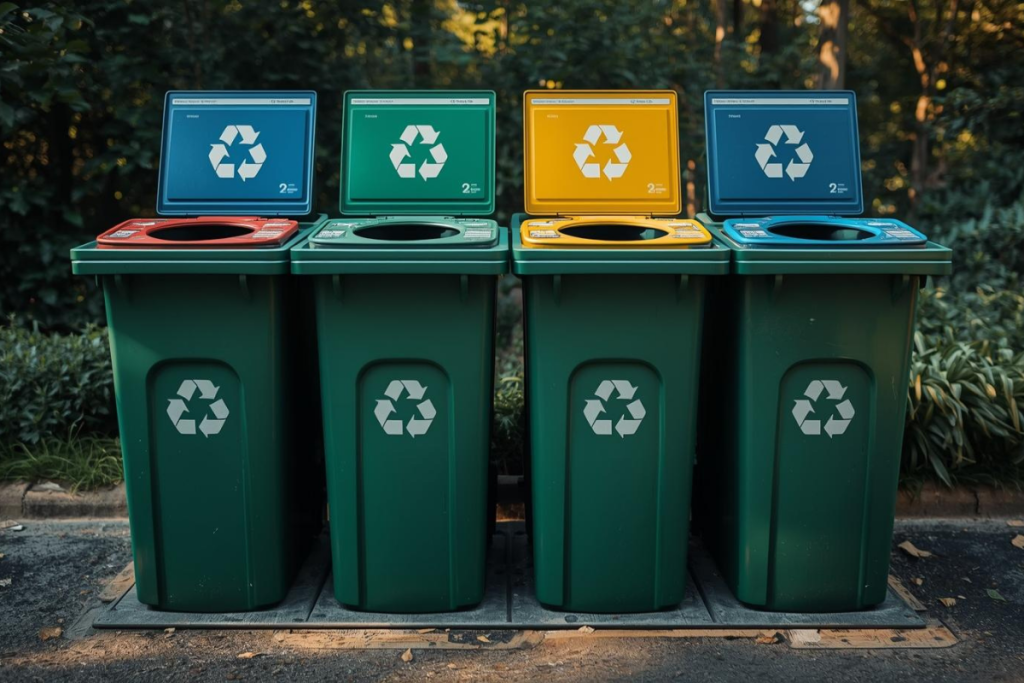
The Department for Environment, Food and Rural Affairs (Defra) is implementing mandatory nationwide waste collection standards through its “Simpler Recycling” initiative. Every household, rental property, and business will separate waste into four standardized streams:
Food waste
Paper and card
Dry recyclables (plastic, metal, glass)
Residual waste
This is not guidance. This is law, enforced under the Environmental Protection Act 1990.
March 2027 brings a second phase: plastic film packaging and plastic bags. These materials account for more than a quarter of all plastic packaging in the UK market, yet only 7% gets recycled.
The Scale of the Challenge
Where England Stands
England’s household recycling rate has flatlined at 44-46% since 2015. Wales hit 57%. Scotland reached 42%. Northern Ireland sits at 50%. Voluntary local approaches failed.
The legally binding target: 65% by 2035. That’s a 21 percentage point jump in 11 years after a decade of stagnation.
The Food Waste Problem
Food waste makes up 30% of black bin contents and is the single biggest cause of recycling failure. When food waste contaminates recycling bins, councils spend more than £250 million annually sorting it out. Separate food waste collection solves this.
Infrastructure Requirements
Only 14% of councils currently collect plastic films and flexibles. That means 86% of local authorities must build this capability from scratch before 2027. Hundreds of thousands of households need new bins and caddies. Councils need new vehicles, adapted facilities, updated contracts, and staff training.
Defra is providing up to £295 million in capital funding for bins and vehicles. A July 2024 survey found 64% of businesses are not ready.
Why National Standards Matter
Research shows 39 different bin regimes across the UK and 3,500 waste recycling plants with varying capabilities. This fragmentation creates confusion. People want to recycle properly, but face unclear messaging and rules that change by location.
Universal standards eliminate guesswork. The rules are the same at home, work, or school. When recycling capability depends on your postcode, participation becomes inequitable. Some communities have clear systems. Others get confused and contaminated bins. National standards fix this.
Legal Enforcement
Councils can issue Section 46 Notices that legally require residents to sort, store, and present bins correctly. Ignoring these is a civil offense similar to fly-tipping. Recycling shifts from voluntary to legally required.
The government states: “Citizens will be able to recycle the same materials across England, whether at home, work or school, and will no longer need to check what is accepted for recycling in their local area.”
The rollout is phased. Food waste collection starts in April 2026. Plastic film collection starts in March 2027. Defra allows councils flexibility in logistics—collection frequency, vehicle routes, storage solutions—but the four categories are non-negotiable.
What This Means for Policy
This reform shifts England from local autonomy to national standards—a recognition that voluntary efforts failed to meet legally binding targets. It follows Wales’ model, which achieved higher recycling rates through standardization.
Industry trials suggest mandated film packaging collection could yield around 123,000 tonnes, adding 5% to UK recycling rates. But collection alone isn’t enough. The 2027 plastic film expansion acknowledges this: collection and processing capabilities must align. Otherwise, collected materials just pile up without anywhere to go.
What Residents Should Expect
Education Campaigns
Councils will launch communication campaigns explaining what goes in each bin. Residents need to understand not just what goes where, but why separation matters—contamination costs councils millions and makes recycling impossible.
New Bins and Collection Schedules
Most households will receive additional bins or caddies for food waste. Some areas may see collection schedule changes. Weekly food waste collection is mandated to prevent odor and hygiene issues. Dry recyclables and residual waste collection frequency varies by council.
Costs
Councils receive government funding for infrastructure, but some may pass costs to residents through council tax. The £295 million funding covers bins and vehicles but not ongoing operational costs.
Compliance
Non-compliance can result in Section 46 Notices, fines, or refusal of collection. Councils can refuse to collect bins that do not comply with sorting requirements. Voluntary approaches failed for years—mandatory standards with enforcement changed that.
Timeline and Next Steps
Now to April 2026
Councils order bins and vehicles
Communication campaigns launch
Businesses develop compliance strategies
Investment in food waste processing facilities
Enforcement framework development
April 2026 to March 2027
Councils implement and refine four-stream collection. Defra monitors compliance and addresses implementation challenges. Businesses adapt waste management contracts.
March 2027 and Beyond
Plastic film collection begins. Only 14% of councils currently have this capability. Building it across 86% of local authorities in under three years is ambitious. Success depends on coordination between national policy, local implementation, infrastructure investment, and public participation.
The Bottom Line
England’s recycling infrastructure has been fragmented for decades. 321 different local authorities operated 39 different systems with 3,500 processing plants of varying capability. This created confusion, inequity, and stagnation.
Standardization removes these barriers. But collection is only the first step. Processing infrastructure must expand. Markets for recycled materials must strengthen. Product design must prioritize recyclability. Implementation must match ambition.
Wales proved national standards work, reaching 57% recycling rates while England stagnated at 44%. England now follows that model, with legal enforcement replacing voluntary participation.
The next two years will determine whether England can close the recycling gap. Infrastructure must be ready. Councils must communicate effectively. Residents and businesses must adapt. Processing facilities must accept and handle the increased volume.
By late 2027, the results will be clear: either England catches up to Wales, or the policy joins the list of environmental reforms that failed in execution.
